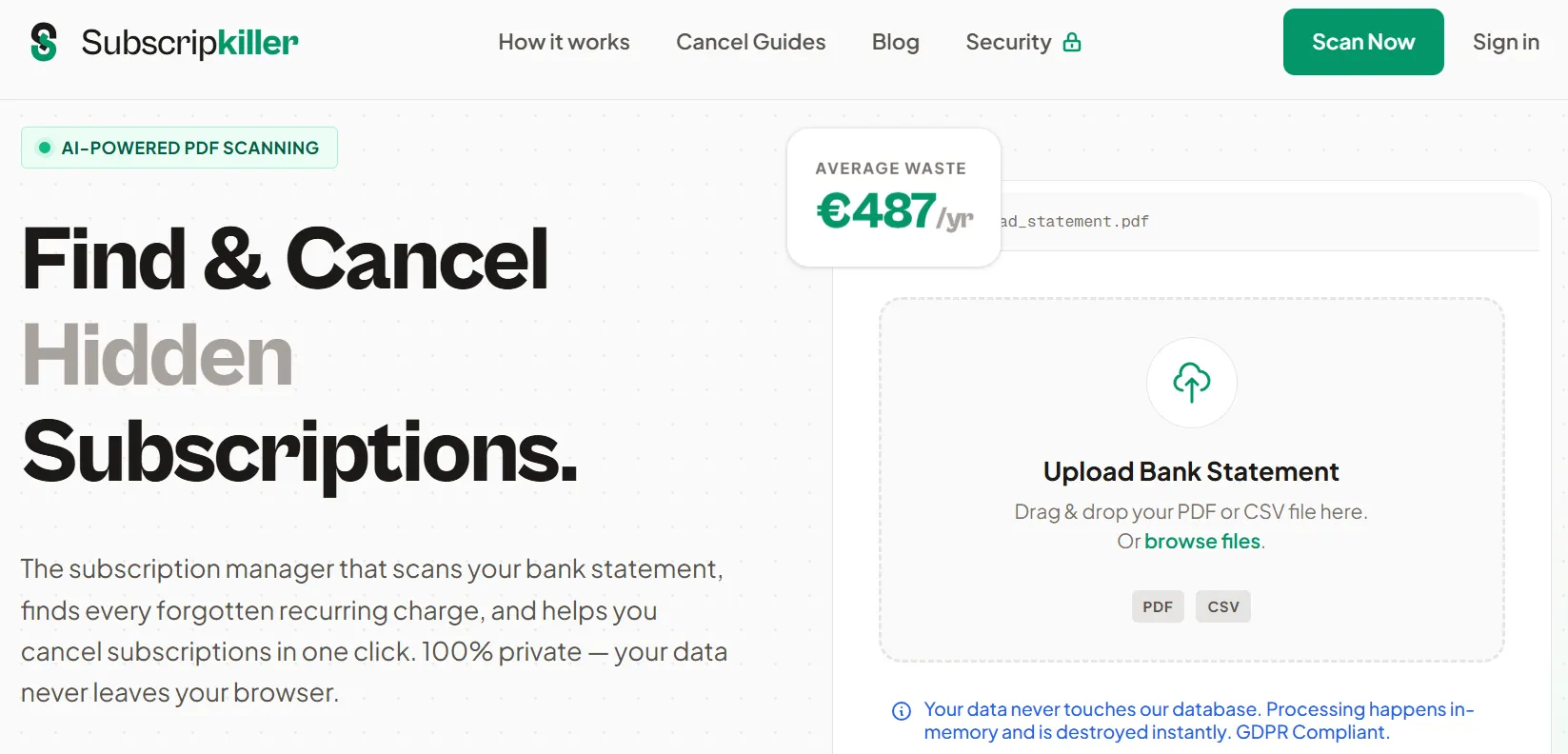
There's a specific kind of financial discomfort that doesn't announce itself loudly. It just accumulates quietly — a streaming service you stopped watching six months ago, a productivity app you downloaded during a remote-work phase that never quite stuck, a premium news site you signed up for during an election cycle and completely forgot existed. Individually, none of these feels like a crisis. Together, though, they can quietly consume more of your monthly budget than you'd ever consciously choose to spend. SubScripkiller is a tool built specifically to surface these hidden costs and give you the information and tools to act on them. This review covers what it does, how it works, who it's actually useful for, and what to keep in mind before connecting your financial accounts to any service of this kind.
What Is SubScripkiller?
SubScripkiller is a subscription management and cancellation tool built to help individuals and households get a complete picture of their recurring digital expenses. The core function is pretty straightforward: the platform analyzes your transaction history — typically by connecting to your bank account or credit card with read-only access — and identifies charges that appear on a recurring schedule. Monthly streaming fees, annual software subscriptions, weekly delivery boxes, quarterly membership dues, and everything in between gets pulled into a single organized view.
But it goes further than a simple spreadsheet would. It categorizes what it finds, flags subscriptions that may have been forgotten or are likely unused based on billing patterns, and gives you tools to either cancel those subscriptions directly or walk through the cancellation process step by step. The goal is to close the gap between what you're actually paying for and what you're genuinely using.
The broader category this tool belongs to — subscription management software — has grown significantly over the past several years, and for understandable reasons. The average person now manages more recurring digital payments than at any previous point in consumer history. A single household might hold active subscriptions across entertainment, news, fitness, cloud storage, software, food delivery, and a rotating cast of app-store charges from mobile games and utility apps. Keeping track of all of it manually is genuinely hard. Tools like SubScripkiller exist because the problem is real and growing. You can explore the platform directly at subscripkiller.com.
Why Hidden Subscriptions Are a Growing Problem in 2026
The subscription economy didn't happen by accident. Businesses figured out that recurring revenue is more stable and predictable than one-time sales, and the industry built an entire infrastructure around making it as easy as possible to sign up and as friction-filled as possible to cancel. Free trials that auto-convert to paid plans. Annual subscriptions buried in fine print when you thought you were signing up monthly. Price increases that go into effect quietly with a single email sent to an inbox you haven't checked in weeks.
The problem has a name in personal finance circles: subscription fatigue. It describes the state where you've signed up for so many services, over such a long period, across so many devices and platforms, that the cognitive load of tracking them all gets too high. And the result? People just stop trying. They pay the monthly charges because investigating each one feels like more trouble than it's worth — until the charges add up into a number they can no longer ignore.
Free trials are a particularly sharp edge of this problem. The design of most trial periods is optimized for conversion, not informed choice. A fourteen-day trial starts on a Tuesday. By the following Wednesday, you've already forgotten about it, your card has been charged, and the subscription is now active with an annual commitment attached. That pattern repeats across dozens of services, and a lot of people only catch it months later when they notice the charge on a statement they actually took the time to read.
Streaming service overload compounds the issue. The era of a single streaming subscription is long over. The market has fragmented into dozens of competing platforms, each holding a portion of the content people actually want, each charging a monthly fee, and each adding features like ad-supported tiers that make the pricing more complicated than it looks at first glance. A household that subscribes to several streaming services, adds a few premium channels, and pays for a music streaming plan is already managing a meaningful monthly recurring expense — and that's before any SaaS tools or mobile apps enter the picture.
Key Features of SubScripkiller
Understanding what SubScripkiller offers at a feature level helps clarify whether it actually addresses the specific problems you're dealing with.
- Automatic Subscription Detection: The platform scans your transaction history to identify recurring charges using pattern recognition. It flags charges that appear at consistent intervals from the same merchant, building a list of active subscriptions without you having to input anything manually.
- Subscription Dashboard: All identified subscriptions show up in a centralized view, organized by category, billing frequency, and cost. This gives you a single reference point for everything you're paying for on a recurring basis — which is honestly the most useful thing here.
- Cancellation Assistance: For supported services, the platform either initiates the cancellation process on your behalf or walks you through it with detailed instructions. The degree of automation varies by service and what the subscription provider actually allows.
- Spending Analysis: Many subscription management tools include some form of spending breakdown — showing your total monthly recurring cost, how it breaks down by category, and how it's changed over time. This context helps you make more informed decisions about which subscriptions are worth keeping.
- Trial Tracker: Built to prevent the forgotten-free-trial problem. You can log active trials and set reminders before the billing date, reducing the chance a trial converts to a paid subscription without you actually deciding to keep it.
- Renewal Alerts: Notifications ahead of subscription renewal dates — especially for annual subscriptions — give you a window to review and cancel before the next billing cycle rather than waking up to a surprise charge after.
- Multi-Account Support: You can connect multiple bank accounts and credit cards so that subscriptions spread across different payment methods all get captured in one place rather than requiring separate tracking for each account.
How SubScripkiller Works
The technical foundation of a service like SubScripkiller is financial data aggregation — connecting to your bank account or credit card with permission-based, read-only access and pulling the transaction history that the platform uses to identify recurring charges. Most services in this category don't store your banking credentials directly. Instead, they use a third-party aggregation service — typically a regulated provider that handles the connection securely — which passes only the transaction data needed for analysis.
The identification process relies on pattern matching applied to the transaction timeline. The platform looks for charges from the same merchant appearing at regular intervals. A charge of a consistent amount showing up on approximately the same date each month from a recognizable service name is a reliable signal of an active subscription. Annual subscriptions require a longer transaction history window to detect, since the recurring pattern only appears once per year. Some platforms also supplement transaction analysis with a merchant database that maps common service names to subscription categories, which improves accuracy when transaction labels are abbreviated or unclear.
Once subscriptions are identified, the platform's cancellation infrastructure takes over for the services it supports. This can take several forms: direct API integration with the subscription service that allows cancellation programmatically, a guided workflow that walks you through the cancellation process on the service's own interface, or in some cases a concierge model where the service contacts the provider on your behalf. The method available depends on what each subscription provider allows and whether the tool has built that integration.
Step-by-Step User Experience
Walking through what using SubScripkiller actually looks like in practice helps set realistic expectations about the process.
Step 1 – Account Setup: Creating an account typically takes an email address and password. Some platforms offer sign-in through Google or Apple for convenience. The initial setup screen then presents the option to connect financial accounts.
Step 2 – Connecting Financial Accounts: You authorize the connection to your bank account or credit card. The platform redirects you to your bank's login interface or uses a regulated aggregation service. You authenticate directly with your bank — your banking credentials go to your bank, not to the subscription management tool itself.
Step 3 – Transaction Scan: The platform analyzes your transaction history, typically looking back three to twelve months depending on how much data the connected account provides. This process usually takes a few seconds to a few minutes.
Step 4 – Review the Results: A list of identified subscriptions appears, organized by category and billing frequency. This is the most important step to do carefully. Automated detection is accurate for clear-cut recurring charges but can occasionally flag transactions that happen to recur without actually being subscriptions. Review the list, confirm which items are genuine subscriptions, and remove any false positives before proceeding.
Step 5 – Decide What to Keep and What to Cancel: Go through the list with fresh eyes. For each subscription, ask honestly: do I use this? Does it deliver enough value to justify what I'm paying? The total monthly recurring cost shown on the dashboard makes the cumulative impact of individual small charges much clearer than looking at each one separately.
Step 6 – Cancel or Manage: For subscriptions you want to end, use the platform's cancellation tools or follow its guided instructions. For subscriptions you're keeping, the dashboard becomes an ongoing record and reminder system for upcoming renewals.
Subscription Management Challenges in 2026
The landscape has genuinely shifted in ways that make subscription management harder than it was even a few years ago. A few trends are worth naming explicitly because they affect how useful any management tool can be.
The proliferation of SaaS tools has been particularly significant for professionals and small business owners. Where a business once bought software outright, it now pays monthly for each tool in its stack — project management, design software, communication platforms, cloud storage, accounting, CRM, email marketing, and more. The total SaaS spend for even a small team can reach a number that would genuinely surprise most founders if they added it up carefully. SubScripkiller and tools like it are now being used in professional contexts, not just personal finance management.
Mobile app subscriptions present a specific technical challenge. A lot of app subscriptions are charged through the Apple App Store or Google Play rather than directly by the app developer. This means they appear in your bank statement as a single charge from Apple or Google — not from the individual app. Transaction-based scanning alone may not surface these subscriptions at the app level unless the tool integrates directly with your Apple or Google account to pull app subscription data separately.
Subscription price creep is another challenge that management tools address imperfectly. Many services raise prices gradually — sometimes by a small enough increment that individual users don't notice unless they're actively tracking what they previously paid. A streaming service that's raised its monthly fee twice in three years is now charging significantly more than when you first subscribed. Management tools that track historical charge amounts can surface this pattern, but not all of them do.
Benefits of Using SubScripkiller
The clearest benefit is visibility. Most people significantly underestimate how much they're spending on subscriptions because the individual charges are small and spread across different billing dates, different cards, and different statement periods. A tool that pulls everything together into one view doesn't need to be perfect to be useful — even a rough total is more actionable than the vague sense that you're probably paying for things you've forgotten about.
The second benefit is friction reduction around cancellation. And look, subscription cancellation is deliberately inconvenient for many services. Some require you to call a phone number during business hours. Others hide the cancellation option behind multiple menus. A few send you through a retention flow that requires declining several offers before actually completing the cancellation. A tool that navigates this process for you — or at least documents exactly where the cancellation option lives and what to expect — meaningfully lowers the barrier to acting on subscriptions you've already decided to cancel.
The third benefit is the reminder and renewal alert system. Annual subscriptions are the category most likely to catch people by surprise. Paying for something annually creates a twelve-month gap between billing moments, which is more than enough time for the service to become irrelevant to your life, for a better alternative to emerge, or for the price to go up significantly. A tool that notifies you thirty days before an annual renewal gives you time to make a deliberate decision rather than waking up to a charge you didn't anticipate.
Security and Privacy Considerations
Any service that requests access to your financial transaction history deserves careful evaluation before you grant that access. The fact that a service is well-designed and apparently useful isn't a substitute for understanding specifically what happens with your data.
The primary questions worth asking before connecting your accounts:
- Read-Only Access: Confirm that the connection to your bank or credit card uses read-only permissions. A subscription management tool has no legitimate reason to initiate transactions or move money. If the access being requested includes anything beyond reading transaction history, that's a red flag worth investigating before you proceed.
- Credential Handling: Understand whether your banking credentials pass through the service or go directly to your bank through a regulated aggregator. Services that use established providers don't see your banking username and password — the aggregator handles authentication on your behalf.
- Data Storage and Retention: The privacy policy should specify what data the service stores, how long it retains that data, and what happens to your data if you delete your account. A service that commits to data deletion upon account closure provides more control than one that retains data indefinitely.
- Third-Party Sharing: Check explicitly whether the service shares transaction data with advertisers, data brokers, or analytics partners. Some free services in this category use aggregated or individually attributed financial data as part of their revenue model.
- Encryption Standards: Transaction data should be encrypted in transit and at rest. Industry-standard encryption is a reasonable minimum expectation for any service handling financial data.
"The value of a subscription management tool depends entirely on whether the trust you place in it is well-founded. Reviewing the privacy policy before connecting your bank account takes ten minutes. Dealing with a data exposure takes significantly longer."
None of these considerations are reasons to avoid tools like SubScripkiller categorically — they're reasons to evaluate them thoughtfully before use. Many subscription management tools have been designed with genuine care for user security and privacy. But user protection in this space comes from informed use, not from assuming a well-designed interface implies a well-designed privacy architecture.
Real-Life Use Cases
Abstract descriptions of what a tool does are useful up to a point. Concrete examples of who actually uses it and why tend to be more clarifying.
The Freelancer With a Sprawling Tool Stack
A freelance designer working across multiple client projects over the past three years has picked up subscriptions to a project management tool, two different design platforms, cloud storage from two providers, a font subscription service, a stock image library, a video editing suite, and a task automation tool. Several of these were for specific projects and aren't actively used anymore. The subscriptions stayed active because canceling each one individually was always deprioritized in favor of actual client work. SubScripkiller identifies the full list in one scan, makes the cumulative monthly cost visible, and provides cancellation paths for the services no longer in use. Sound familiar?
The Student Managing a Tight Budget
A university student signed up for several streaming services during summer break, took advantage of a student pricing offer on a productivity suite, started a fitness app trial that quietly converted to a paid plan, and subscribed to a study tool recommended by a professor. Living on a semester budget, they want a clear picture of what they're actually paying every month and whether any of those services are truly essential for the current term. A subscription audit through SubScripkiller gives them that picture in minutes rather than an afternoon of digging through bank statements.
The Family Household With Overlapping Services
Two working parents with teenagers in the house have, collectively, signed up for streaming services through individual accounts, gaming subscriptions for different platforms, a music streaming service, a family photo storage plan, and several education apps for the kids. Some of these overlap — two family members have separate subscriptions to the same service under different accounts. The household dashboard reveals the overlap and the full picture of recurring digital expenses, giving the parents the information they need to consolidate and cut back.
The Professional Approaching a Budget Review
A professional preparing for an annual personal finance review wants to document all recurring expenses before building a budget for the coming year. Rather than digging through twelve months of bank statements manually — which, honestly, almost nobody actually does — SubScripkiller surfaces the complete list of recurring charges in a format that's easy to review and act on before the budget planning session.
Comparison With Traditional Subscription Tracking Methods
People managed subscriptions before tools like SubScripkiller existed, and some of those methods are still worth considering in context.
Manual spreadsheet tracking is the most common alternative. It works well for people who are disciplined about maintaining it and who already know what subscriptions they have. But it requires proactive upkeep — you have to remember to add a subscription when you sign up, remove it when you cancel, and update amounts when prices change. It doesn't discover subscriptions you've forgotten about.
Reviewing bank statements manually is thorough but genuinely time-consuming. Going through a year of transactions line by line to identify recurring charges is an afternoon project that most people postpone indefinitely. A tool that automates this process saves significant time at the cost of requiring account access.
Email inbox search — searching for terms like "subscription," "receipt," or "renewal" — can surface some subscriptions through billing confirmation emails. This approach is limited by how consistently services actually send email confirmations and how organized your inbox is. It also doesn't calculate totals or identify patterns across time.
SubScripkiller's advantage over all three methods is the combination of automation and breadth. It surfaces subscriptions you may have genuinely forgotten without requiring either manual data entry or hours of manual review. The trade-off is the account access required and the associated privacy considerations discussed above.
Pros and Cons
Strengths
- Automated subscription discovery reduces the time required to audit recurring expenses from hours to minutes
- Centralized dashboard gives a clear total picture of monthly and annual recurring costs
- Cancellation assistance genuinely lowers the practical barrier to acting on unused subscriptions
- Renewal alerts prevent surprise charges from annual subscriptions
- Trial tracking helps prevent forgotten free trials from quietly converting to paid plans
- Multi-account support captures subscriptions spread across different payment methods
Limitations to Consider
- Requires connecting financial accounts, which means sharing transaction data with the platform
- App store subscriptions may not be fully visible through bank transaction analysis alone
- Automated cancellation isn't available for every subscription service
- Pattern recognition can occasionally produce false positives that require manual review
- Annual subscriptions require sufficient transaction history to detect accurately
- The quality of privacy protections varies by platform and should be independently verified — don't just assume
Who Should Use SubScripkiller?
The tool adds the most value for a specific profile of user. If you recognize yourself in any of the following descriptions, a subscription management tool is likely worth evaluating seriously.
You're a strong candidate if you have more than eight to ten active subscriptions, if they're spread across multiple credit cards or bank accounts, if you've signed up for multiple free trials in the past year, or if you've recently received a bank statement and noticed a charge you couldn't immediately identify. You're also a strong candidate if you're approaching a budget planning period and want an accurate baseline for your recurring expenses.
The tool is less necessary — though still potentially useful — if you have a small number of subscriptions you actively track, if you already maintain a reliable manual tracking system, or if you're unwilling to connect financial accounts to a third-party service. In that last case, a manual entry mode — if the platform offers one — might give you organizational benefits without the data-sharing element.
Families managing shared subscriptions across multiple household members, small business owners tracking SaaS spend, and students on fixed budgets are particularly well-suited to what the tool offers. Honestly, the households and individuals most likely to have the largest gap between what they think they're spending and what they're actually spending are precisely the ones with the most to gain from an automated audit.
Pricing Overview
Subscription management tools in this category typically run on one of two pricing models. The first is a freemium structure: a free tier that provides basic subscription detection and dashboard features, with a paid tier — usually in the range of a few dollars per month or a modest annual fee — that unlocks full cancellation assistance, advanced analytics, and priority support. The second is a performance model where the service is free to use but takes a percentage of verified savings generated through its cancellation assistance.
For SubScripkiller specifically, the current pricing structure should be verified directly on the official SubScripkiller website, as pricing in this category changes frequently and third-party listings can quickly become outdated. What's worth knowing going in is that the value proposition of a subscription management tool is strongest when the subscriptions it helps you cancel exceed the cost of the service by a meaningful margin. A tool that costs a few dollars per month and helps you identify even one forgotten subscription is paying for itself if that subscription was costing more than the tool's fee.
Free trials for the tool itself are common in this category — somewhat fittingly for a service built to help you manage free trials elsewhere. If a trial is available, use it to run a full subscription audit before deciding whether the paid features justify the ongoing cost. Head to subscripkiller.com to check what's currently on offer.
Tips for Managing Digital Subscriptions Effectively
A tool like SubScripkiller is most effective when combined with broader habits around subscription management. These practices reduce the problem at the source, which is ultimately more efficient than dealing with subscription accumulation after the fact.
- Use a dedicated email address for subscription sign-ups. This keeps billing confirmations, renewal notices, and trial expiration emails in one searchable place rather than scattered across your primary inbox where they get buried.
- Set a calendar reminder whenever you start a free trial. Put the trial end date on your calendar with a two-day buffer so you have time to decide whether to keep or cancel before the charge hits. This costs thirty seconds when you sign up and saves you from a recurring payment you didn't intend to start.
- Use a virtual card number for trials when possible. Some banks and fintech services offer temporary virtual card numbers that can expire or be locked after a single charge. Using one for a free trial eliminates the auto-conversion risk entirely.
- Review all subscriptions quarterly rather than annually. An annual review catches forgotten subscriptions, but a quarterly review prevents them from running for nine months before you notice. Thirty minutes four times per year is enough to stay on top of most household subscription lists.
- Ask yourself the replacement question before subscribing. Before adding a new subscription, identify what it replaces or what specific problem it solves. If the answer is vague, the subscription is a good candidate for cancellation within the first month.
Best Practices for Reducing Subscription Waste
Beyond individual management habits, there are structural practices that significantly reduce subscription accumulation over time.
Consolidation is often more valuable than cancellation. Before canceling a subscription entirely, check whether a competing service you already pay for offers similar features. A lot of people pay for two services that overlap significantly because they subscribed to each at different times without comparing them directly. Choosing one and canceling the other saves money while maintaining the capability.
Family or group plans change the economics of several subscription categories substantially. A streaming service that costs twelve dollars individually often costs seventeen dollars for a family plan that covers four to six accounts. If multiple people in the same household are paying individually for the same service, switching to a shared plan can reduce combined spending significantly — and it's one of the easiest wins available.
Annual billing versus monthly billing is worth evaluating deliberately rather than just defaulting to monthly for convenience. Most subscription services offer a meaningful discount — typically fifteen to twenty-five percent — for annual billing. For services you're confident you'll use for at least twelve months, the annual plan typically offers better value. For services you're uncertain about, monthly billing preserves the flexibility to cancel without losing prepaid time.
Common Mistakes People Make With Recurring Payments
The patterns that lead to subscription waste are consistent enough that they're worth naming directly.
The most common mistake is treating the monthly cost as the relevant number without calculating the annual impact. A service that costs eight dollars per month sounds negligible in isolation. Across a year, it costs nearly a hundred dollars. Across five similar services, that's nearly five hundred dollars annually. The annual number is the one that belongs in a budget; the monthly number is what service providers show you because it looks smaller. And that's intentional.
The second common mistake is signing up for a service to solve a specific short-term problem without building in a cancellation plan. You need a design tool for a one-time project. You subscribe, complete the project, and then deprioritize cancellation because it feels minor. Three months later, you've paid for the tool twice more without opening it. The fix is simple: if you subscribe for a specific purpose with a known end date, put the cancellation date on your calendar the same day you sign up.
The third mistake is not reviewing the subscription after a price increase notice. Most services send an email before raising prices — often with enough lead time to cancel before the higher rate takes effect. Treating those emails as spam rather than as decision prompts is a habit that costs money over time. A renewed subscription at a higher price is a spending decision, even if you made it by not reading an email.
The Future of Subscription Management Tools
The direction this category is heading is toward deeper integration and more proactive management. The next generation of subscription management tools is likely to move beyond detection and toward prediction — identifying subscriptions that behavioral signals suggest are underused before you explicitly review them, and surfacing cancellation recommendations rather than waiting for you to initiate the process.
Integration with open banking frameworks, which are expanding in many markets, will make transaction data access more standardized and potentially more privacy-conscious than current methods. Regulatory pressure around subscription transparency — particularly around free-trial-to-paid conversions and cancellation friction — is also growing in several major markets, which may reduce some of the problems that management tools currently address by changing the practices that create them in the first place.
AI-driven analysis is already beginning to appear in more sophisticated versions of subscription management tools. Rather than simple pattern matching, these systems can identify subscriptions that have shifted in usage, flag when a service has released a new lower-cost tier that would suit the user better, or model the annual savings from a proposed set of cancellations against the user's historical spending patterns. These capabilities make the tools significantly more proactive and personalized than the first generation of subscription trackers.
The category will almost certainly grow rather than shrink. The subscription economy isn't reversing — if anything, it continues to expand into new product categories that have historically been one-time purchases. Tools that help consumers navigate that landscape with clarity and control are addressing a structural need that isn't going away.
Frequently Asked Questions About SubScripkiller
Is SubScripkiller a legitimate service?
SubScripkiller is built as a subscription tracking and cancellation tool intended to help consumers identify and manage recurring charges. As with any service that requires access to financial data, you should review the platform's terms of service, privacy policy, and security practices carefully before connecting any accounts. Verifying that the service uses industry-standard encryption and doesn't sell personal data to third parties is a reasonable first step before signing up. Looking for independent reviews and checking whether the company behind the product is transparent about its ownership and operations also helps establish legitimacy.
Is it safe to connect my bank account to SubScripkiller?
SubScripkiller, like most financial aggregation tools, typically uses read-only access protocols when connecting to your bank or credit card accounts. This means the service can view your transaction history to identify recurring charges but can't move or withdraw funds. That said, safety depends heavily on how well the platform implements encryption, what data it stores, and how long it retains that data. Always check whether the service uses a regulated third-party aggregator such as Plaid or a similarly established provider, and review the privacy policy before granting any access.
What data does SubScripkiller collect and store?
Subscription management tools generally collect transaction metadata — amounts, merchant names, dates, and billing frequency — to identify recurring charges. They don't typically require or store your banking credentials directly when using regulated aggregation services. The privacy policy should specify what data is collected, how long it's retained, whether it's shared with third parties, and what your rights are around data deletion. Reading that document before connecting accounts is an important step if data privacy matters to you.
Can SubScripkiller actually cancel subscriptions on my behalf?
Some subscription management tools offer automated or assisted cancellation features, while others identify subscriptions and provide guidance on how to cancel them yourself. Whether SubScripkiller can cancel subscriptions directly depends on the specific services it has built integrations with and the cancellation methods that subscription providers allow. For services requiring phone calls or written requests, the tool may provide instructions rather than automated cancellation. It's worth confirming what the cancellation process looks like for each specific subscription before assuming it happens automatically.
Which banks and financial institutions does SubScripkiller support?
Coverage varies depending on the financial aggregation infrastructure the service uses. Major national banks and large credit card providers are typically supported. Smaller regional banks, credit unions, and prepaid card providers may have limited or no support depending on whether they participate in open banking frameworks or connect through the aggregation service used. Checking the platform's supported institutions list before signing up will clarify whether your primary accounts are covered.
Does SubScripkiller charge a fee to use its service?
Subscription management tools in this category typically use either a freemium model — with a free basic tier and paid premium features — or a performance model where the service shares a percentage of savings generated. The specific pricing structure for SubScripkiller should be verified directly on their official website, as pricing in this category evolves frequently and any third-party listing may not reflect the current offer. Looking for a free trial before committing to a paid plan is always a sensible approach.
Will SubScripkiller find subscriptions from mobile apps and app stores?
Subscriptions charged through the Apple App Store or Google Play can be harder to detect through bank transaction analysis alone, because they appear as charges from Apple or Google rather than from the individual app developer. Some subscription management tools integrate directly with Apple and Google accounts to surface app-level subscriptions separately. Whether SubScripkiller offers this capability should be verified on the platform, as app store subscriptions can represent a significant and often overlooked chunk of total recurring digital spend.
How does SubScripkiller identify hidden or forgotten subscriptions?
The core mechanism is pattern recognition applied to transaction history. The service scans past transactions for recurring charges — amounts that appear at regular intervals from the same merchant — and flags them as likely subscriptions. This works well for consistent monthly or annual charges. It can occasionally flag one-time purchases that happen to appear more than once, so reviewing the identified list manually before taking cancellation action is always a worthwhile step.
Can I use SubScripkiller without connecting my bank account?
Some subscription management tools offer a manual entry mode where users can input their own subscriptions without connecting financial accounts. This approach is more private but requires you to already know about the subscriptions you want to track, which limits the automatic discovery benefit. If bank connectivity isn't something you're comfortable with, checking whether a manual mode is available gives you the organizational features without the data-sharing element. The discovery value is significantly reduced, but the dashboard and reminder functions remain useful.
Is my information shared with advertisers or third parties?
Reputable subscription management tools specify clearly in their privacy policies whether personal or financial data is shared with advertisers, data brokers, or other third parties. A service that generates revenue from subscription fees has less financial incentive to monetize user data than one offering entirely free services without a clear alternative revenue model. Reviewing the privacy policy specifically for language around data sharing, third-party partnerships, and advertising use of transaction data is the most reliable way to assess this risk for your specific situation.
Who benefits most from using SubScripkiller?
The people who benefit most are those with a large number of digital subscriptions spread across multiple payment methods, individuals who frequently sign up for free trials and lose track of cancellation deadlines, households where multiple family members manage separate subscriptions that may overlap, and budget-conscious users who want a clear picture of their total recurring expenses. Students, freelancers, small business owners managing SaaS tools, and anyone who's switched banks or cards recently and lost track of which subscriptions are still active are particularly well-suited to what the tool offers.
Final Verdict
The problem SubScripkiller addresses is genuine and growing. The average person in 2026 manages more recurring digital payments than at any point in consumer history, and the structure of how subscriptions are sold — easy to start, deliberately inconvenient to cancel, priced monthly to make the annual cost less visible — is calibrated to accumulate charges beyond what people would consciously choose to pay if they were presented with the full picture at once.
A subscription management tool that surfaces that full picture automatically, without requiring hours of manual statement review, and that reduces the friction around canceling services you no longer use has clear and practical value. SubScripkiller positions itself to deliver exactly this kind of value, and for users who match its target profile — multiple subscriptions, multiple payment methods, some history of forgotten free trials — it addresses a real financial pain point with a straightforward and usable approach.
The considerations worth keeping in mind are also real. Connecting financial accounts to any third-party service is a trust decision that should be made deliberately, with the privacy policy actually read and the data-handling practices understood. Automated cancellation isn't available for every service and shouldn't be assumed before verifying the specific cancellation flow for each subscription. App store subscriptions may require additional account connections to surface fully. And the tool's value, like all financial management tools, depends on you actually reviewing and acting on the information it provides — the audit is useful; the action is what saves money.
For anyone who's glanced at a bank statement and felt the vague discomfort of not being entirely sure which of those small recurring charges are still worth paying, SubScripkiller offers an efficient way to replace that vagueness with clarity. Whether that clarity translates into savings depends on what you do with it. The tool makes the decision easier. But the decision remains yours to make.
If you want to run your own subscription audit, visit SubScripkiller at subscripkiller.com to get started and see what recurring charges are hiding in your accounts.
Managing your subscriptions is one of the highest-return, lowest-effort personal finance actions available to most people in 2026. The challenge has never been knowing that unused subscriptions cost money — it's been having a clear enough picture to actually act. That's the gap a good subscription management tool fills.