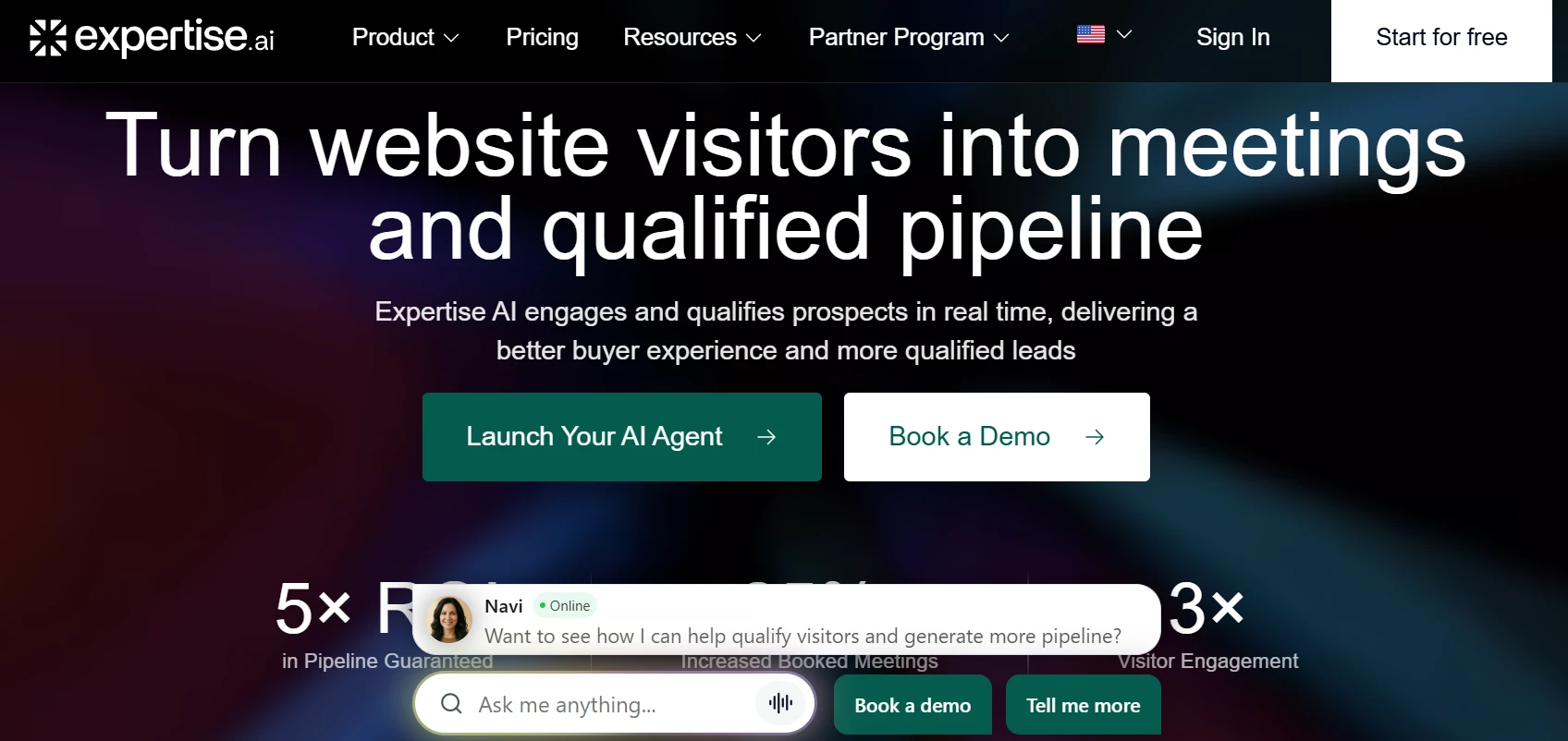
Expertise AI Review: The AI Sales Assistant That Turns Website Visitors Into Meetings and Qualified Pipeline

Here is a scenario that plays out at B2B companies every single day. A potential buyer visits your website, reads your pricing page, spends time on your product features, and then quietly leaves without ever filling out a form. No meeting booked. No name captured. No opportunity created. Just a visit that turned into nothing — even though that person was exactly the kind of buyer you wanted to talk to. The gap between website traffic and actual pipeline is one of the most expensive problems in B2B sales, and it rarely gets talked about as loudly as it should. Expertise AI was built specifically to close that gap. It uses conversational AI to engage visitors the moment they land, qualify them through natural dialogue, and automatically book meetings with the ones who actually fit your ideal customer profile — without waiting for a human to respond. This review covers what it is, how it works, who it is built for, and whether it genuinely delivers on that promise.

Expertise AI at a Glance

  • What it is: An AI-powered website visitor conversion and lead qualification platform
  • Primary use case: Engaging inbound visitors, qualifying leads, and booking meetings automatically
  • Best suited for: B2B SaaS companies, agencies, startups, and enterprise sales teams with inbound website traffic
  • Key differentiator: Conversational AI that qualifies and books meetings 24/7, replacing passive forms and slow follow-up cycles
  • Pricing: Visit the official website for current plans — pricing varies by usage and features
  • Official site: expertiseai.com

What Is Expertise AI?

Expertise AI is an AI-powered sales assistant platform designed to convert passive website visitors into active sales conversations — and ultimately into booked meetings and qualified pipeline. Instead of relying on static lead capture forms and manual follow-up sequences that can take hours or days to reach a hot prospect, Expertise AI deploys a conversational AI layer directly on your website that engages visitors in real time, asks the right qualifying questions, and routes qualified buyers directly to your calendar.

The platform is built for B2B companies that invest in driving traffic to their website — through content marketing, paid ads, SEO, or outbound campaigns — but find that most of that traffic evaporates without converting into meaningful pipeline. The traditional alternatives to this problem are either expensive (hire more SDRs to manually follow up faster) or ineffective (put a basic chatbot on the site that frustrates visitors with rigid scripts). Expertise AI aims to be a smarter third option: AI that genuinely understands what a visitor is trying to accomplish, converses naturally, qualifies against your specific criteria, and books the meeting while the prospect is still warm and engaged.

At its core, the product sits at the intersection of conversational AI and sales automation. It is not just a chatbot in the traditional sense — it uses large language model technology to handle the kind of open-ended, nuanced conversations that older rule-based systems simply could not manage. And it is not just a scheduling tool — the qualification layer means that the meetings it books are with real prospects, not anyone who happens to click a link.

Why Businesses Need AI-Powered Visitor Conversion Tools

Before getting into the specifics of how Expertise AI works, it is worth being honest about the scale of the problem it is solving. The disconnect between website traffic and actual sales pipeline is bigger than most companies realize — and the traditional approaches to fixing it have real, structural limitations.

Most Website Visitors Never Convert

The average B2B website converts somewhere between one and three percent of visitors into any kind of lead — and of those leads, a meaningful portion never result in a sales conversation. That means that for every hundred qualified buyers who visit a typical B2B website, ninety-seven or more leave without creating any pipeline opportunity. Some of those visitors were genuinely not ready to buy. But many were interested, evaluating options, and would have engaged if they had received the right prompt at the right moment. The gap is not just a traffic problem — it is an engagement timing problem.

Lead Forms Are Passive and Slow

The standard response to this problem — the "contact us" form, the "request a demo" button, the gated content download — is fundamentally passive. It asks the visitor to take all the initiative, fill out fields, and then wait for someone on your team to follow up. By the time a sales development representative gets to that lead, the prospect has often already moved on to a competitor, booked a demo somewhere else, or simply lost the momentary intent that drove them to your site in the first place. Studies consistently show that the first company to respond to an inbound inquiry wins the meeting far more often than the second — and minutes matter, not hours.

Manual Qualification Is Expensive and Inconsistent

Even when companies invest in faster follow-up — more SDR headcount, tighter SLAs, better lead routing — the qualification process itself is expensive and inconsistent. Different SDRs ask different questions. Some leads get thorough discovery, others get a rushed five-minute call. The quality of what reaches the account executive is uneven, which means sales cycles start with incomplete information and deals that looked promising in the pipeline sometimes collapse because the foundational qualification work was never done properly. Systematizing qualification is hard when it depends on human performance that varies by individual, time of day, and how recently the SDR had coffee.

After-Hours Traffic Goes Completely Unaddressed

A significant portion of B2B website traffic arrives outside of business hours — evenings, early mornings, weekends, international time zones where your team is not yet online. For companies selling to global markets or to buyers who research outside of nine-to-five windows, this means a substantial share of warm, high-intent visitors simply encounter nobody. Not a slow response — a complete absence of engagement. That traffic cost you real money to acquire. Letting it disappear without even trying to start a conversation is a compounding loss that adds up quickly over months and years.

How Expertise AI Works

Expertise AI sits on top of your existing website as an intelligent engagement layer. The mechanism is fairly straightforward once you understand the components, but the execution is more sophisticated than it might initially appear.

Step 1 — Visitor arrives on your site. When a visitor lands on a page — your homepage, a product page, a pricing page, or a campaign landing page — Expertise AI detects the visit and, based on your configuration, decides whether and how to initiate engagement. The trigger logic can be as simple as a timed prompt or as sophisticated as behavior-based activation tied to scroll depth, page type, referral source, or visitor firmographic data from enrichment integrations.

Step 2 — The AI initiates a natural conversation. Rather than a generic pop-up asking "Can I help you?", the AI opens with a context-aware message relevant to what the visitor is looking at. If they are on the pricing page, the opening might acknowledge that and offer to help them understand which plan fits their needs. The conversational tone is designed to feel like a knowledgeable team member starting a genuine dialogue, not a scripted bot fishing for an email address.

Step 3 — Qualification happens through conversation. As the dialogue unfolds, Expertise AI weaves qualification questions naturally into the exchange. It is gathering the information your sales team needs — company size, use case, current solution, timeline, budget range, decision-making process — but doing it in the flow of a helpful conversation rather than as an interrogation. The AI can handle follow-up questions, clarify its own responses, and adapt to the direction the visitor takes the conversation.

Step 4 — Qualified leads get routed or booked directly. When a visitor meets your qualification threshold, Expertise AI offers them a direct path to a meeting — presenting available calendar slots in real time and confirming the booking without any human involvement. Visitors who do not meet the criteria can be directed to self-serve resources, a lower-touch follow-up flow, or a form for the marketing team — keeping the sales team focused exclusively on qualified pipeline.

Step 5 — Data flows into your CRM and calendar. Every conversation, qualification outcome, and booked meeting syncs automatically to your CRM and calendar integrations. Your sales team arrives at each meeting with full context about the prospect's stated needs, qualification status, and what was discussed during the AI conversation — removing the need for cold starts and reducing early-stage sales cycle friction.

Key Features of Expertise AI

The platform's capabilities span the full visitor-to-meeting workflow. Here is a closer look at what each major feature area actually does and why it matters.

Conversational AI Engagement

The conversational engine is what separates Expertise AI from traditional website chat tools. Built on large language model technology, the AI can understand visitor intent from naturally phrased messages, handle multi-turn dialogue, ask follow-up questions contextually, and maintain coherence across a full conversation — without falling apart when a visitor asks something unexpected. This makes the engagement feel genuinely helpful rather than automated, which meaningfully affects how willing visitors are to participate in the qualification process. People are far more likely to answer questions when they feel like they are having a real conversation than when they sense they are being processed by a script.

Intelligent Lead Qualification

Expertise AI allows you to define your ideal customer profile and qualification criteria in the platform configuration. The AI then evaluates every conversation against those criteria in real time, scoring visitors as the dialogue progresses and making routing decisions accordingly. Qualification parameters can include firmographic signals like company size and industry, behavioral signals like which pages were visited and for how long, and conversational signals gathered directly from the visitor's responses. The result is a qualification process that is consistent — every visitor goes through the same criteria — and scalable — it runs simultaneously across all active conversations without any human involvement.

Automated Meeting Scheduling

Once a visitor qualifies, the path to a meeting should be as frictionless as possible — and Expertise AI makes it genuinely frictionless. The AI presents real-time calendar availability, handles time zone conversion automatically, and confirms the booking within the conversation flow. No separate scheduling links to send. No back-and-forth email chains to find a mutually available time. No risk of the prospect cooling off while waiting for a human to respond with availability. The meeting is booked while intent is highest, which makes a measurable difference in show rates and the overall quality of first conversations.

Visitor Intelligence and Enrichment

Expertise AI can integrate with data enrichment tools to add firmographic context to visitor profiles — company name, industry, revenue range, employee count, technology stack — based on IP data or email identification. This gives the AI richer context to inform how it approaches each conversation and gives your sales team deeper background on each prospect before the meeting. For companies with account-based marketing programs, this enrichment layer means the AI can also recognize target accounts and trigger priority routing or personalized messaging for high-value visitors, treating them differently from general traffic.

Sales Pipeline Generation

The cumulative effect of the qualification and booking workflow is a continuously fed pipeline of meetings with buyers who already meet your criteria and have expressed genuine interest. This is a meaningfully different kind of pipeline from the typical mix of inbound form fills that includes everything from students doing research to your existing customers logging in with the wrong email. Every meeting Expertise AI generates has been through a qualification filter — which means your sales team's time is concentrated on opportunities with real potential rather than distributed across a broad, noisy inbound funnel.

CRM and Calendar Integrations

Expertise AI connects with the CRM and calendar tools that most B2B sales teams already use, ensuring that qualified lead data and meeting records flow into existing workflows without requiring manual data entry or separate tracking. When a meeting is booked, the prospect record — including conversation transcript, qualification status, and firmographic data — appears in the CRM before the meeting happens. This eliminates the gap between website engagement and sales team awareness that is responsible for so many leads being worked ineffectively or not at all.

Customizable Qualification Playbooks

Different products, different market segments, and different campaign contexts call for different qualification approaches. Expertise AI allows teams to build multiple qualification playbooks and assign them to specific pages, traffic sources, or visitor segments. A visitor coming from a Google Ads campaign for a specific product feature can encounter a different conversational flow than one arriving organically on the homepage — with qualification criteria and routing logic tailored to the specific intent that brought them there. This flexibility is important for teams running sophisticated inbound programs where a one-size-fits-all approach would leave value on the table.

24/7 Autonomous Operation

Expertise AI runs continuously without human oversight, which means it is generating meetings and qualifying leads during every hour of every day — including the hours when your SDR team is offline. For companies with global audiences or buyers who research outside business hours, this continuous availability is not a minor convenience; it is a structural advantage. Every visitor who arrives at two in the morning from a time zone where your team is asleep gets the same quality engagement as one who arrives at ten in the morning on a Tuesday.

Automated Follow-Up Sequences

For visitors who engage but do not immediately qualify or book a meeting — perhaps they are earlier in their evaluation process, or they are gathering information for a decision that is a few months out — Expertise AI can trigger automated follow-up sequences that nurture the relationship over time. These sequences keep your brand present as the prospect continues their evaluation, surface relevant content based on what was discussed in the initial conversation, and re-engage the lead when signals suggest their timing has changed. This extends the platform's value beyond immediate booking conversion into longer-cycle pipeline development.

Top Benefits of Using Expertise AI

When the platform is working as intended, here is what actually changes for the businesses using it.

More qualified pipeline from existing traffic. Before adding Expertise AI, a significant share of website traffic leaves without generating any opportunity. After deployment, that traffic is actively engaged, and the subset that qualifies gets converted into meetings. The same traffic that was previously producing limited results starts generating measurable pipeline — without any increase in the underlying traffic cost.

Faster response time for high-intent prospects. The traditional follow-up cycle — form submission, CRM entry, SDR assignment, email outreach, phone call — can take hours or days. With Expertise AI, the engagement is immediate: the moment a qualified buyer is on your site is the moment the conversation starts and the meeting gets booked. Response time goes from hours to seconds, which is the single most important variable in converting inbound interest into sales conversations.

Consistent qualification every time. Human qualification is inherently variable. Two SDRs asking the same questions will hear different things, probe differently, and pass different quality leads forward. Expertise AI applies the same criteria consistently to every visitor — no variation by time of day, no drift in what questions get asked, no deals slipping through a qualification process that felt thorough but actually was not. Consistency in qualification translates directly to consistency in pipeline quality.

Sales team focused on closing, not prospecting. When the AI handles the top-of-funnel engagement and qualification work, your sales team's time shifts toward activities that require genuine human skill: building relationships, navigating complex negotiations, managing multi-stakeholder deals. The administrative top-of-funnel work that currently consumes a disproportionate share of SDR time gets offloaded to the AI, which is both faster and more consistent at it anyway.

Pipeline visibility and meeting data in one place. Every conversation, qualification outcome, and booked meeting flowing into the CRM creates a cleaner, more complete record of how pipeline is actually being generated — which makes reporting more accurate and optimization more data-driven. Marketing teams get better signal on which campaigns and content assets are producing qualified pipeline, not just raw traffic.

Real-World Use Cases

The practical value of Expertise AI becomes clearest when you look at specific scenarios where it changes what is possible for a sales organization.

SaaS Companies With High Inbound Traffic

A B2B SaaS company running content marketing and paid acquisition is generating thousands of website visits per month but converting a fraction of a percent into demo requests. The SDR team is spending most of its time on outbound prospecting and cannot realistically cover the inbound volume with the quality and speed it requires. Expertise AI handles every inbound visit in real time, qualifies visitors against the company's ICP, and books demos directly — delivering the SDR team a calendar of pre-qualified meetings rather than a queue of cold leads to work through. Pipeline from inbound increases substantially without adding headcount.

Agencies Selling B2B Services

A digital marketing or consulting agency gets most of its new business inquiries through its website, but the quality of those inquiries is inconsistent and the follow-up process is ad hoc. Prospects who fill out a contact form sometimes wait two or three days for a response, by which point they have often already engaged with a competitor. Expertise AI engages every inquiry immediately, asks qualifying questions about budget, timeline, and project type, and books discovery calls only with prospects who fit the agency's client profile. Discovery calls become more efficient because the AI has already gathered the baseline information, and the close rate on proposals improves because the qualification work was done properly before the first conversation.

B2B Startups With Small Sales Teams

An early-stage B2B startup with a two-person sales team cannot afford to have both salespeople spending time on top-of-funnel qualification when their highest leverage is in closing deals and gathering product feedback. Expertise AI effectively acts as an AI SDR — handling all website visitor engagement, running qualification, and filling the calendar with meetings so the sales team can focus entirely on converting those meetings into customers. For startups where every qualified meeting represents a meaningful percentage of the pipeline, the compounding effect is significant.

Enterprise Sales Teams Managing High-Volume Inbound

An enterprise software company with a large marketing engine is generating thousands of inbound leads per month, but the qualification process is creating a bottleneck before leads reach account executives. Some high-quality enterprise leads are waiting days for a response because they are mixed in with a high volume of low-fit inquiries that SDRs have to sift through. Expertise AI segments the inbound volume in real time, routing high-fit visitors to immediate meeting booking while handling lower-priority traffic with automated nurturing flows. High-value prospects get faster attention, SDRs focus on complex qualification that genuinely requires human judgment, and AEs receive a cleaner pipeline of enterprise-caliber opportunities.

Marketing Teams Running Paid Campaigns

A demand generation team investing in Google Ads, LinkedIn campaigns, or event-driven traffic needs those campaigns to produce pipeline, not just visits. When campaign traffic lands on a page with a static form, conversion depends entirely on the visitor choosing to fill it out — and most do not. Adding Expertise AI to campaign landing pages means that visitors arriving from specific campaigns can be engaged with messaging and qualification flows tailored to that campaign's context, converting a higher percentage of paid traffic into actual meetings. This improves the measurable ROI of the paid program and gives marketing clearer signal on which campaigns are producing pipeline-quality traffic.

Revenue Operations Teams Improving Pipeline Quality

A RevOps team responsible for pipeline health and forecasting accuracy is dealing with inconsistent qualification data in the CRM — deals that looked strong in early stages frequently stall because the foundational qualification was never truly completed. By deploying Expertise AI with structured qualification playbooks tied to the CRM stage definitions, every new opportunity that enters the pipeline has a documented qualification conversation attached to it. Pipeline quality improves, early-stage deal scoring becomes more reliable, and forecasting accuracy increases because the data the forecast is based on reflects genuine qualification rather than optimistic stage assignments.

Expertise AI Pricing

Pricing information for Expertise AI varies depending on factors like conversation volume, the number of seats, integration requirements, and which features are included at different tiers. Platforms in this category typically structure pricing around a combination of base platform access and usage-based elements tied to the volume of visitor conversations and meetings generated.

Entry-level plans are generally designed to be accessible for startups and small teams that want to get started with AI-powered visitor conversion without enterprise-level commitments. Mid-tier plans typically unlock higher conversation volumes, more sophisticated qualification playbooks, and deeper CRM integrations. Enterprise plans add custom integration support, dedicated customer success, advanced analytics, and the security and compliance features required by larger organizations.

Because pricing in this space changes frequently and depends heavily on company-specific needs and negotiated terms, the most accurate current information is available directly on the official Expertise AI website. Visit expertiseai.com for the latest pricing details. When evaluating the cost, compare it not just against similar tools but against the current cost of the SDR time, opportunity cost of unengaged visitors, and the pipeline value being generated — that is the most honest ROI calculation.

Pros and Cons

A fair assessment of any platform includes an honest look at both sides. Here is a balanced view of what Expertise AI does well and where it has limitations worth considering.

Pros Cons
Engages visitors immediately, 24/7, without human involvement Value scales with traffic volume — lower-traffic sites may see limited impact early on
Consistent qualification applied to every visitor Initial configuration of qualification criteria and playbooks requires thoughtful setup
Reduces time-to-engagement from hours to seconds AI conversations cannot fully replicate the nuance of an experienced human SDR in complex scenarios
Automated meeting booking removes friction and back-and-forth Prospects unfamiliar with AI chat may occasionally disengage if they prefer human interaction
CRM integration keeps pipeline data current without manual entry Pricing may be a consideration for early-stage startups with limited budgets
Frees sales team to focus on closing rather than top-of-funnel tasks Ongoing playbook optimization required to maintain qualification quality as ICP evolves
Generates cleaner, more consistent pipeline data for forecasting Integration depth with niche CRM tools may vary — verify specific compatibility
Scales to handle high-volume inbound without proportional headcount increases AI insights improve over time as conversation data accumulates — less calibrated initially

Expertise AI vs Traditional Lead Generation Methods

To understand where Expertise AI genuinely adds value, it helps to compare it directly with the approaches it is meant to improve upon.

Capability Traditional Approach Expertise AI
Visitor engagement Passive forms, static CTAs Active AI conversation, real-time engagement
Lead qualification Manual SDR calls, inconsistent criteria Automated, consistent AI-driven qualification
Response time Hours to days after form submission Immediate — engagement starts in seconds
After-hours coverage None — visitors leave without engaging Full 24/7 autonomous coverage
Meeting booking Email chains, scheduling back-and-forth Instant booking within the conversation
Pipeline quality Mixed — depends on SDR performance and process Consistently filtered by defined ICP criteria
CRM data entry Manual, often delayed or incomplete Automated, immediate, includes conversation context
Scalability Linear — requires headcount growth Non-linear — handles volume increases without added cost
Consistency Variable by rep, time of day, and workload Identical process for every visitor, every time
Cost to generate a meeting High — SDR salary, tools, management overhead Lower per meeting as volume scales
"The best time to engage a website visitor is the moment they are on your site, thinking about your product, and open to a conversation. The second-best time is never — because by then they have already moved on."

Expertise AI Alternatives

Expertise AI is not the only platform in the AI-powered visitor conversion and B2B lead qualification space. Understanding the competitive landscape helps you make a more informed decision about which tool is the right fit for your specific situation.

  • Drift (now Salesloft): One of the earliest players in the conversational marketing space, Drift built its reputation on pipeline acceleration through chat-based engagement. After its acquisition by Salesloft, it is increasingly positioned as part of an integrated sales engagement suite. Strong enterprise capabilities, but pricing and complexity may be more than smaller teams need.
  • Qualified: A strong option particularly for Salesforce-native organizations. Qualified sits directly on top of Salesforce data, which means it can personalize visitor engagement using CRM context about known accounts and contacts. Its account-based approach is especially powerful for companies running ABM programs. Generally positioned toward mid-market and enterprise buyers.
  • Intercom: Originally built for customer support, Intercom has expanded into sales and marketing use cases. Its AI assistant and conversation routing capabilities cover visitor engagement reasonably well, though its primary identity remains a customer communication platform rather than a dedicated pipeline generation tool. Good for teams that want a single tool covering both pre-sale and post-sale conversations.
  • HubSpot Chatflows: For companies already running HubSpot as their CRM and marketing platform, HubSpot's built-in chatflows and AI assistant provide decent visitor engagement and lead routing natively within the ecosystem. Less sophisticated than dedicated pipeline AI tools, but the zero-friction integration with HubSpot's broader system makes it appealing for teams deeply embedded in that stack.
  • Mutiny: A personalization platform that focuses on adapting website content dynamically based on visitor segment — particularly useful for account-based programs where different messaging is shown to different target accounts. Complementary to rather than a replacement for conversational qualification tools.
  • Landbot: A no-code chatbot builder that allows teams to create conversational flows without writing code. More accessible for smaller teams with simpler qualification needs, but less AI-native than Expertise AI — the conversational intelligence is more dependent on how well the flow was designed than on underlying AI adaptability.
  • Chili Piper: Focused primarily on the meeting scheduling and routing side of the equation — excellent at instantly routing inbound form fills to the right rep and enabling direct booking. Less focused on the AI-driven qualification conversation layer, but a strong complement if you already have a qualification process in place and mainly need better routing and scheduling.

Who Should Use Expertise AI?

Not every company is equally positioned to benefit from an AI-powered visitor conversion platform. Here is a realistic breakdown of who is most likely to see genuine return from deploying Expertise AI.

  • B2B SaaS companies with consistent inbound traffic that are generating leads but not converting them efficiently — especially those where the SDR team is stretched across both inbound qualification and outbound prospecting. The AI handles inbound so the team can focus where human judgment and relationship-building matter more.
  • Agencies and professional services firms where the quality of new business inquiries is inconsistent and the follow-up process is informal. Expertise AI standardizes qualification and ensures that every inquiry gets a fast, intelligent response regardless of who is available on the team.
  • Startups with small sales teams that need to maximize the productivity of every person on the team without adding headcount. An AI SDR that runs around the clock lets a two-person sales team operate with the inbound coverage of a much larger organization.
  • Revenue operations teams focused on improving pipeline quality and forecasting accuracy. Consistent, documented qualification conversations attached to every new opportunity create a cleaner data foundation for pipeline analysis and revenue prediction.
  • Marketing teams investing in paid acquisition that need campaign traffic to convert into pipeline, not just into form fills and MQLs. Expertise AI improves the conversion rate from paid visits to booked meetings, making the ROI of campaign spend measurably better.
  • Enterprise sales organizations managing high inbound volumes where SDR bottlenecks are causing high-value prospects to wait too long for a response. Automated first engagement and qualification routing ensures that high-fit visitors get immediate attention while lower-priority traffic is handled appropriately through automated flows.

Expertise AI may be less of an immediate fit for very early-stage companies with minimal website traffic, businesses with predominantly outbound sales motions where inbound conversion is not a meaningful driver, or organizations with extremely complex, highly technical sales processes where the initial qualification genuinely requires deep human expertise to execute well. That said, for the majority of B2B companies with meaningful inbound traffic, the value proposition is clear and the use case is direct.

Tips for Getting the Best Results

Teams that see the strongest outcomes from AI-powered visitor conversion platforms tend to share a set of implementation and operational habits. Here is what tends to produce results — and what tends to undermine them.

  • Define your ICP before you configure, not after. The quality of Expertise AI's qualification output depends entirely on the quality of the criteria you give it. Before building your playbooks, get specific about what a qualified lead actually looks like — not "a mid-sized company" but "a 50-to-500 person B2B SaaS company with a sales team of at least five, evaluating solutions for pipeline management." The more precise your criteria, the more useful the qualification filtering becomes.
  • Deploy on your highest-intent pages first. Pricing pages, product feature pages, and demo request pages attract visitors who are actively evaluating — not just browsing. Start Expertise AI on those pages where visitor intent is highest, and expand to broader site coverage once you have validated the qualification flow and booking experience. You will learn faster, generate results sooner, and make optimization decisions with better data.
  • Write your opening messages for the specific page context. A generic opener like "How can I help you today?" will underperform compared to one that acknowledges what the visitor is likely thinking about on that page. "Exploring our enterprise plan? Happy to answer questions and help you figure out if it is the right fit" is a fundamentally more engaging start than a blank prompt.
  • Review conversation transcripts regularly, especially early on. The AI will occasionally encounter questions or objections it handles less well than others. Reading through actual conversation transcripts in the first weeks of deployment reveals exactly where the AI needs better context or where the qualification flow needs adjustment. This is low-effort optimization that meaningfully improves performance over time.
  • Connect your CRM and calendar before going live. The value of Expertise AI is compounded when every conversation and booked meeting flows automatically into the systems your team is already using. Setting up integrations before launch means that from day one, your pipeline data reflects the AI-generated activity and your sales team has full context in their existing tools — rather than creating a parallel system they have to check separately.
  • Communicate the change to your sales team. When Expertise AI starts booking meetings, the sales team's experience of their inbound pipeline changes. Making sure they understand where those meetings are coming from, what qualification information is available in the CRM record, and how to use the conversation context in their meeting prep ensures they capture the full value of every AI-generated opportunity.

Frequently Asked Questions About Expertise AI

What is Expertise AI?

Expertise AI is an AI-powered website visitor conversion and lead qualification platform that uses conversational AI to engage visitors in real time, qualify them against your ideal customer profile, and automatically book meetings with buyers who meet your criteria. It operates 24/7 without human involvement, replacing passive contact forms and slow follow-up cycles with an intelligent dialogue that converts website traffic into qualified sales pipeline around the clock.

How does Expertise AI qualify leads?

Expertise AI qualifies leads through natural conversation. The AI asks targeted questions — about company size, role, use case, timeline, current solutions, and budget range — woven naturally into the dialogue rather than presented as a rigid form. It evaluates visitor responses against your predefined qualification criteria in real time and scores each lead accordingly. Only visitors who meet your threshold are offered a direct path to booking a meeting, while those who do not qualify are handled through alternative flows — nurture sequences, self-serve resources, or a standard inquiry form for the marketing team.

Is Expertise AI suitable for startups?

Expertise AI can be an excellent fit for startups, particularly those with small sales teams that need inbound coverage without the cost of additional SDR headcount. The platform effectively acts as an AI sales development representative — handling all website visitor engagement and qualification continuously without taking a salary or sick days. For very early-stage companies with minimal website traffic, the full impact scales with visitor volume, but building the infrastructure early means it is in place and optimized when traffic grows.

Does Expertise AI integrate with CRMs?

Expertise AI connects with common CRM platforms so that lead data, qualification outcomes, and booked meeting records flow automatically into your existing systems. When a meeting is booked, the prospect record — including the full conversation transcript and qualification status — is created or updated in the CRM before the meeting happens, giving your sales team full context going in. Specific CRM integrations available should be confirmed on the official platform, as supported connections are updated as the product develops.

Can Expertise AI automate meeting booking?

Yes — automated meeting booking is one of the platform's core capabilities. When a visitor qualifies through the AI conversation, Expertise AI presents real-time calendar availability and allows the prospect to book directly within the chat interface, with automatic time zone handling and instant confirmation. The entire process — from qualifying conversation to confirmed calendar invite — happens without any human involvement, which means meetings are booked while the visitor's intent and engagement is at its highest point.

What makes Expertise AI different from a regular chatbot?

Traditional chatbots follow scripted decision trees that can only handle inputs they have been explicitly programmed for. If a visitor asks something outside the script, the chatbot either fails or falls back to a generic response. Expertise AI uses large language model technology that understands natural language, handles multi-turn conversation, and adapts dynamically to where the visitor takes the dialogue. The result is a conversational experience that feels genuinely intelligent rather than scripted — which matters a lot for visitor engagement and qualification completion rates. People engage differently when they feel they are talking to something that actually understands them.

Does Expertise AI work 24/7?

Expertise AI operates continuously, including evenings, weekends, and international time zones where your team is offline. This is one of the clearest advantages over human-staffed chat: there is no after-hours gap where qualified buyers arrive on your site and leave without any engagement. Every visitor who arrives outside of business hours receives the same quality AI conversation and, if they qualify, the same ability to book a meeting as someone who arrives during peak hours.

How long does it take to set up Expertise AI?

The core setup involves configuring the AI with your product and company context, defining qualification criteria and conversation playbooks, connecting calendar and CRM integrations, and embedding the widget on your website. For most teams with a reasonably clear ICP and existing CRM setup, the initial deployment can be completed in a matter of hours to a couple of days. More complex configurations — multiple qualification playbooks for different segments, advanced routing logic, deep CRM customization — take longer but typically still within a manageable implementation window. The official onboarding documentation from Expertise AI will provide the most accurate guidance for your specific setup.

Is Expertise AI worth it?

The ROI calculation comes down to how much qualified pipeline is currently being lost from website traffic that goes unengaged or under-served by slow, inconsistent follow-up. For most B2B companies with meaningful inbound traffic, the answer is: quite a lot. If your current inbound conversion rate is around one to two percent and a meaningful share of those leads still never result in a sales conversation, the incremental pipeline from automated engagement and qualification will typically produce a return that significantly exceeds the platform cost. The fairest test is calculating what one additional qualified meeting per week is worth in pipeline value over a quarter — and then asking whether the platform price is smaller than that number.

What are the best alternatives to Expertise AI?

The main alternatives in this space include Drift (now part of Salesloft), Qualified — especially strong for Salesforce-heavy organizations — Intercom, HubSpot Chatflows for teams already in the HubSpot ecosystem, Chili Piper for routing and scheduling-focused use cases, and Landbot for teams that want a no-code conversational flow builder. Each has a different emphasis, pricing model, and target market. The right choice depends on your tech stack, team size, traffic volume, and whether you need a dedicated pipeline generation tool or a broader customer communication platform.

Ready to Stop Letting Website Visitors Slip Away?

Explore Expertise AI and see how conversational AI can turn your existing website traffic into a steady stream of qualified meetings and pipeline — without adding headcount.

Explore Expertise AI →

Final Verdict

The problem Expertise AI is solving — the consistent failure of B2B websites to convert interested visitors into sales conversations — is one of the most pervasive and expensive inefficiencies in modern go-to-market operations. Every team that has invested in content, SEO, or paid acquisition knows the frustration of watching traffic analytics while wondering why a fraction of that traffic ever becomes pipeline. The traditional answer has been either more SDR headcount or better forms — and neither has ever been a satisfying solution. More headcount is expensive and slow, and better forms are still passive.

Expertise AI's approach — deploying conversational AI that engages, qualifies, and books in real time — is genuinely different in kind, not just in degree. The shift from passive to active engagement, from slow follow-up to immediate conversation, from inconsistent human qualification to systematized AI criteria, represents a structural improvement in how inbound pipeline gets generated. For companies where website traffic is a meaningful part of the go-to-market motion, that is not a marginal optimization — it is a different category of outcome.

The considerations worth keeping in mind are also real. The platform's value scales with traffic volume, so lower-traffic sites should set realistic expectations about near-term pipeline impact. Initial configuration quality directly determines qualification quality, which means the setup investment is worth taking seriously rather than rushing. And like any AI system, the conversational intelligence improves with time and data, so early adopters should plan for an optimization period rather than expecting perfect performance from week one.

But for the B2B companies where inbound conversion is a genuine priority — SaaS teams, agencies, startups, demand generation-driven organizations — Expertise AI addresses the problem with both the right technology and the right workflow design. The combination of 24/7 availability, consistent qualification, and friction-free meeting booking removes the three most common failure points in inbound conversion simultaneously. That is a compelling case for adding it to the stack.

If you have been watching website traffic drive minimal pipeline and wondering whether there is a better way to activate that audience, expertiseai.com is worth exploring. The visitors are already there — the question is whether you are making it easy enough for the right ones to become meetings.

The best pipeline you can generate is from buyers who are already on your website, already thinking about your product, already open to a conversation. The only thing standing between that moment and a booked meeting is whether someone — or something — was there to start the dialogue.

Key Takeaways

  • Expertise AI converts passive website traffic into qualified meetings using conversational AI — replacing slow forms and manual follow-up with immediate, intelligent engagement.
  • The platform operates 24/7, which means after-hours visitors in any time zone receive the same quality engagement as those who arrive during business hours.
  • Consistent, criteria-based qualification ensures that every meeting booked through the AI has been through the same filter — improving pipeline quality and forecasting reliability.
  • CRM integration means qualified lead data and booked meeting records flow into existing workflows automatically, with no manual data entry required.
  • The strongest use cases are B2B SaaS companies, agencies, startups with small sales teams, and marketing teams running paid acquisition campaigns where traffic-to-pipeline conversion is a measurable priority.
  • Success depends on the quality of initial configuration — a well-defined ICP and thoughtfully built qualification playbooks are the foundation that everything else builds on.
  • For current pricing and integration details, visit the official platform at expertiseai.com — pricing in this category changes frequently and varies by usage and team size.