Zealos Review: The AI Operating System That Gives Founders and Revenue Teams a Unified Command Center for Growth

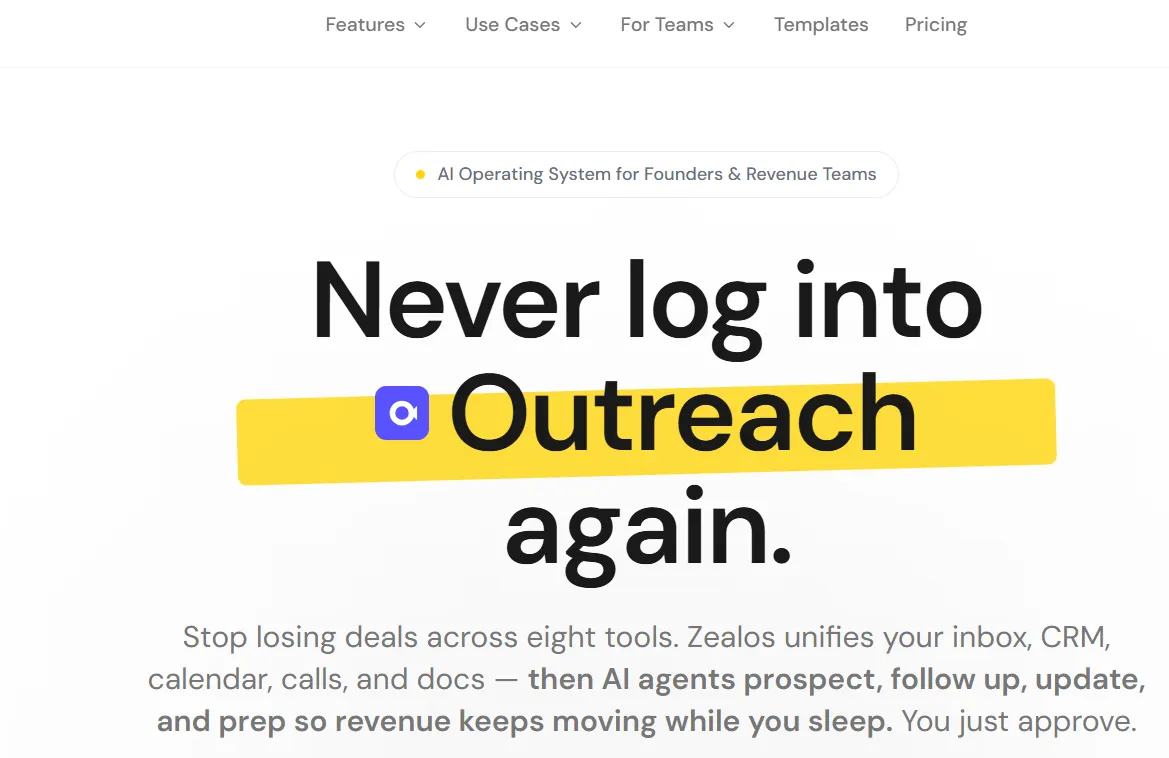
There's a specific kind of operational chaos that every founder recognizes but rarely admits out loud: the morning that starts with ten browser tabs, a CRM that hasn't been updated in four days, a sales forecast living in a spreadsheet that nobody fully trusts, a Slack thread about a deal that went cold, and a board meeting in forty-eight hours that somehow needs a coherent revenue narrative. The tools exist. The data exists. The problem is that none of it talks to each other, none of it speaks the same language, and pulling actual insight out of that pile takes hours that could have been spent moving the business forward. Zealos was built for exactly this problem. It positions itself as an AI operating system for founders and revenue teams — replacing tool sprawl with unified intelligence, and reactive firefighting with proactive, AI-driven decision support. This review covers what it does, how it actually works, who it's genuinely suited for, and what to keep in mind before adding it to your stack.

Zealos at a Glance

  • What it is: An AI operating system for founders and revenue teams
  • Primary use case: Revenue intelligence, pipeline visibility, workflow automation, and strategic decision support
  • Best suited for: Startup founders, CROs, RevOps leaders, GTM teams, and B2B sales organizations
  • Key differentiator: End-to-end AI layer across the revenue workflow, not a single-point tool
  • Pricing: Check official website for current plans — varies by team size and features
  • Official site: zealos.io

What Is Zealos?

Zealos is an AI-powered platform built to serve as the central operating layer for founders and the revenue teams they lead. The term "AI operating system" is intentional here — Zealos isn't trying to be another CRM, another sales engagement tool, or another analytics dashboard. It's built to function as the connective tissue sitting above your existing tools, aggregating the data they generate, applying AI intelligence to it, and surfacing the insights and automations that help your revenue operation run more efficiently and predictably.

At its core, the platform addresses a real tension in how modern startups manage revenue. The tools available to sales and operations teams today are, individually, actually pretty good. CRMs track customer relationships. Pipeline tools visualize deal flow. Engagement platforms automate outreach. Analytics dashboards report on performance. The problem isn't the quality of any single tool — it's the fragmentation between them. Data lives in silos. Workflows break at the handoffs between platforms. Founders end up spending significant time just assembling a coherent picture of business health from fragments scattered across systems that were never designed to talk to each other.

Zealos approaches this by providing a unified AI intelligence layer that spans the revenue workflow — from prospecting through close, and from individual deal management all the way up to strategic business planning. The goal is to give founders a real-time command center for their revenue operation, and give their sales and operations teams AI-powered tools to execute more effectively on the strategy that command center is feeding them.

Why Traditional Revenue Operations Are Broken

Before looking at what Zealos actually offers, it's worth being honest about the structural problem it's solving. The dysfunction in most startup revenue operations isn't random — it follows very predictable patterns that almost every founding team hits as they scale.

Tool Sprawl and Integration Debt

The average growth-stage B2B startup uses a pretty staggering number of revenue-adjacent tools: CRM, sales engagement platform, revenue intelligence software, conversation intelligence, forecasting tools, reporting dashboards — and that's just the common ones. Each was purchased at a different time to solve a specific problem. The cumulative result is a fragmented stack where the same data exists in multiple places, quality degrades with every manual handoff, and the total cost of ownership — in subscription fees, integration maintenance, and human time managing the stack — often far exceeds what anyone on the team realizes. It creeps up on you.

Data Silos and Visibility Gaps

When revenue data lives across disconnected tools, the natural consequence is everyone working from a different version of reality. The sales rep sees her pipeline one way. The sales manager sees a different aggregated view. The CRO is working from a forecast model that may not actually reflect what's in the CRM. And the founder is trying to reconcile all three perspectives into a board-ready narrative before Thursday. The time spent on that reconciliation — and the decisions made poorly because it was never done correctly — is a significant and genuinely underappreciated drag on startup performance.

Forecasting That Nobody Actually Trusts

Sales forecasting in most early-stage companies is a combination of bottom-up pipeline reviews, top-down adjustments based on manager gut feel, and the occasional manual scrub of deal statuses that may or may not reflect reality anymore. The result is a forecast the finance team doesn't fully believe, the board treats skeptically, and the founder privately regards as a best guess rather than a reliable planning input. Building real forecasting discipline is possible — but it requires operational infrastructure that most startups just haven't invested in building yet.

Communication Bottlenecks and Coordination Costs

As revenue teams grow beyond three or four people, coordination overhead starts to compound fast. Status updates, pipeline reviews, deal escalations, SDR-to-AE handoffs — without systematic support, all of this flows through informal channels where context gets lost, actions get dropped, and accountability goes fuzzy. The meeting load required to compensate for the absence of good operational infrastructure is itself a massive productivity tax on the people who should be spending their time actually selling.

How Zealos Works

The architecture of Zealos is built around a unified data layer that serves multiple stakeholder needs at the same time. Rather than requiring separate logins, separate reports, and separate workflows for different roles, the platform gives a single environment where founders, sales leaders, operations professionals, and individual contributors each get the view and tools relevant to their specific function — all drawing from the same underlying data.

The AI layer applies machine learning and pattern recognition to data aggregated from across the revenue workflow. This produces several categories of real value: predictive insights about deal and pipeline health, automated workflows that reduce manual operational overhead, decision support that surfaces the right information at the right moment, and trend analysis that helps leaders spot emerging patterns before they become problems or missed opportunities.

The founder experience centers on a high-level dashboard that translates granular pipeline data into the kind of strategic visibility a company leader actually needs: revenue trajectory, key metric trends, forecast confidence, early warning indicators for risks. Rather than forcing the founder to dig through CRM records just to understand how the business is performing, Zealos surfaces that understanding proactively — in a format built for strategic decision-making, not operational record-keeping.

The revenue team experience centers on workflow automation, pipeline management, and AI-driven guidance that helps individual contributors and managers work more effectively. Less time logging, less time analyzing, more time on the human-intensive work of actually closing deals and building relationships.

Key Features of Zealos

The platform's feature set covers the full revenue operation — from strategic planning tools for founders to tactical execution tools for sales teams. Here's what each major capability area actually does.

AI Operating System Layer

The AI OS layer is what separates Zealos from point solutions. Rather than a single AI feature bolted onto a traditional tool, Zealos is built from the ground up around AI as the primary mechanism for processing, interpreting, and acting on revenue data. The AI layer surfaces patterns across the full dataset — deal histories, engagement signals, pipeline velocity, conversion rates — that no human analyst could process manually at the same speed or scale. This shifts the role of revenue leaders from spending time on analysis to spending time on the decisions and relationships that analysis should be informing.

Revenue Intelligence and Analytics

Revenue intelligence is basically the translation of raw pipeline and activity data into something you can actually act on. Zealos provides trend analysis across conversion rates, average deal size, sales cycle length, and pipeline coverage ratios — presented in context that makes the numbers meaningful rather than just overwhelming. When a particular deal stage shows an unusual drop-off rate, or when pipeline coverage is trending below what's needed to support the monthly forecast, the platform surfaces that signal proactively. It doesn't wait for a manager to notice it in a manual review. That kind of continuous monitoring is what makes AI-native platforms qualitatively different from traditional analytics dashboards that only report on what already happened.

Founder Dashboard and Business Visibility

The founder dashboard is built to answer the questions company leaders actually ask: Are we on track to hit the number? Where are the biggest risks in the pipeline right now? What's driving the variance from forecast? What do the next ninety days look like at current trajectory? In most startups, answering these questions requires a painful manual exercise every week. Zealos makes the answers continuously available, updated in real time as deals progress and data flows from connected sources. That alone is worth something.

Sales Team Coordination and Pipeline Management

For sales teams, Zealos provides pipeline management that goes beyond a standard CRM view. Deal scoring, velocity indicators, next-action recommendations, and risk flags give sales reps and managers real-time context about which deals actually deserve attention, which are moving smoothly, and which need intervention. The coordination layer helps manage handoffs, escalations, and deal-specific communication without requiring everything to flow through informal channels or yet another meeting.

Workflow Automation

Automation in Zealos targets the operational overhead that eats disproportionate time in revenue teams without generating proportionate value. Routine activity logging, CRM data enrichment, follow-up scheduling, internal alert routing, reporting compilation — all categories where automation cuts friction and human error at the same time. The people who benefit most are the salespeople spending significant parts of their day on admin tasks instead of being in front of customers, and the RevOps professionals who are still building those reports by hand.

Forecasting and Predictive Analytics

Zealos applies AI-driven probabilistic forecasting to the pipeline, generating revenue projections based on actual deal behavior and historical patterns — not manually assigned stage probabilities that might reflect optimism more than data. Confidence intervals, scenario modeling, and what-if analysis let founders and revenue leaders stress-test their plans and prepare for multiple outcomes rather than betting everything on a single point estimate. This is particularly valuable for board communications and investor updates, where the quality of your forecasting process is itself a signal of how operationally mature the company is.

CRM Integration and Data Unification

Zealos works alongside existing CRM infrastructure rather than requiring you to rip and replace. Integration with common CRM platforms lets the AI layer draw on the customer and deal data already in your system without forcing a migration or creating a parallel data management burden. Unifying data from CRM, communication tools, and engagement platforms into a single intelligence layer is what makes all the broader analytics and automation capabilities actually possible.

Customer Intelligence

Beyond pipeline data, Zealos aggregates signals about customer behavior and engagement that enrich the picture of individual account health. Engagement frequency, response patterns, expansion signals, churn risk indicators — all of this gives account management and customer success teams the context they need to manage relationships proactively rather than reactively. For recurring revenue businesses, detecting early signs of churn risk or expansion opportunity has direct, measurable impact on net revenue retention. It's not a nice-to-have; it's how you protect your ARR.

Decision Support Tools

Decision support is probably the least visible but most strategically valuable capability in Zealos. Rather than leaving founders and revenue leaders to synthesize analysis from multiple sources and apply judgment in isolation, the platform provides AI-generated recommendations and scenario analysis that inform decisions around resource allocation, territory planning, quota setting, and go-to-market strategy. To be clear: this doesn't replace founder judgment. It improves the quality of information that judgment is operating on. That's a meaningful distinction.

Benefits for Founders

The value Zealos provides to founders specifically addresses the operational challenges that most commonly prevent company leaders from operating at their highest strategic level. Here's what actually changes.

Real-time business visibility is the most immediate shift. Instead of piecing together a mental model of business performance from fragmentary sources, founders using Zealos have continuous access to a coherent, data-driven view of where the company actually stands. This changes the quality of conversations with their team, their board, and their investors — from impressionistic and approximate to evidence-based and specific.

Faster, better-informed decisions follow naturally from better visibility. When the data supporting a strategic decision is readily available and actually trustworthy, the time to make that decision drops and the odds of getting it right go up. For founders navigating the fast-moving, high-stakes environment of a growth-stage company, that's a compounding advantage that's hard to overstate.

Reduced operational overhead lets founders delegate revenue operations more effectively. When the operating system is managing the routine analytical and coordination work, the founder can redirect attention toward the highest-leverage activities: recruiting, strategic partnerships, product direction, and customer relationships at the level where founder involvement creates outsized value.

Investor-ready reporting becomes a byproduct of normal operations rather than a separate fire drill before each board meeting. The metrics, trends, and forward-looking projections that boards and investors want to see are continuously maintained and accessible, which cuts the prep burden that many founders find quietly crushing.

Benefits for Revenue Teams

For the sales, RevOps, and go-to-market professionals actually running the revenue engine day-to-day, Zealos addresses a different but equally real set of frustrations.

Pipeline clarity and deal prioritization help individual contributors and managers allocate attention more effectively across a portfolio of deals. When AI-driven deal scoring surfaces which opportunities are most likely to close and which are showing risk signals, the team can focus energy where it's most likely to generate results — rather than distributing effort uniformly across all active deals regardless of quality. That distinction matters more than it sounds in a busy pipeline.

Reduced administrative load means more time actually selling. The automation in Zealos targets the specific tasks with the lowest value-to-time ratio in a salesperson's workflow — activity logging, data entry, report generation, routine follow-up management. Cutting that overhead has direct impact on the time available for relationship-building and deal advancement. And frankly, salespeople feel the difference immediately.

Better cross-team alignment comes from shared data visibility. When sales, RevOps, finance, and leadership are all looking at the same pipeline data and working from the same forecasting framework, the coordination cost of aligning on plans, priorities, and resource needs drops substantially. The energy that typically goes into reconciling different versions of the truth gets redirected toward actually improving the numbers.

Accountability and performance visibility improve when activity and outcome data is captured systematically and made visible consistently. This builds a performance culture based on data rather than anecdote — which is more equitable for individual contributors and genuinely more useful for managers trying to coach and develop their teams.

Real-World Use Cases

The value of a platform like Zealos becomes clearest in specific operational situations — the kinds of things that are happening at hundreds of startups right now. Here are a few scenarios that reflect how different organizations actually put it to work.

SaaS Startup Preparing for a Series A

A B2B SaaS company with eight salespeople approaching its Series A needs to demonstrate not just revenue performance but revenue predictability — the ability to forecast accurately and the operational infrastructure to sustain growth at a higher scale. The founder is spending four to six hours a week manually compiling metrics from three different systems just for the investor data room and the weekly update. With Zealos centralizing revenue data and automating reporting, those hours get redirected to the investor conversations themselves. And the quality of the pipeline data, the accuracy of the forecasting model — those become visible proof of operational discipline that investors consistently cite as a Series A evaluation criterion. That's not a soft benefit; it directly affects your odds.

B2B Sales Team Struggling With Forecast Accuracy

A twenty-person sales organization finds its quarterly forecasts are consistently missing by twenty to thirty percent in either direction. Resource planning and hiring decisions become unreliable as a result, and sales managers are spending most pipeline review time manually assessing deal quality rather than actually coaching their team. Zealos applies AI-driven deal scoring and pipeline health analysis across the full dataset, surfacing leading indicators — engagement frequency, multi-stakeholder involvement, competitive signals — that correlate more reliably with deal outcomes than the stage probability values sitting in the CRM. Forecast accuracy improves, pipeline review meetings get faster and more substantive, and managers get back the time for coaching that was being consumed by data reconciliation.

Revenue Operations Team Scaling a Multi-Product GTM Motion

A RevOps team supporting a company that's expanded from one product to three now has to manage separate pipelines, separate quota frameworks, and separate reporting for each product line — while still providing consolidated business-level views to the executive team. The cross-product data management overhead is consuming most of the team's capacity. Zealos unifies all three product pipelines into a single intelligence layer, so the RevOps team can maintain product-level detail while producing consolidated views with minimal manual effort. The team shifts from data assembly to higher-value work: territory optimization, compensation design, the stuff that actually moves the needle.

Venture-Backed Startup Scaling a GTM Team Quickly

A post-Series B company is adding ten salespeople over six months. Onboarding new hires into a complex, fragmented tool stack takes weeks and produces inconsistent results — everyone learns it differently and uses it differently. With Zealos as the central operating layer, new team members have a single interface that gives them immediate visibility into their assigned pipeline, clear guidance on next actions for each deal, and access to AI-driven insights that previously required months of experience with the company's specific sales motion. Ramp time shortens, and consistency improves across the board.

CEO Preparing Board Materials Monthly

A CEO at a growth-stage company spends two full days before each board meeting manually pulling together revenue metrics, pipeline data, and forward projections from multiple systems. The process is error-prone, time-consuming, and almost always surfaces at least one question at the board meeting that requires a follow-up afterward because the data wasn't available in the room. With Zealos maintaining continuous, real-time visibility and producing automated reporting views, board prep becomes a review and presentation exercise rather than a data assembly exercise. The materials are more complete, the prep time drops significantly, and the CEO walks into the meeting knowing the numbers cold.

Zealos vs. Traditional Revenue Tech Stack

The question most founders and revenue leaders face when evaluating Zealos is how it fits relative to — or potentially replaces — the tools already in their stack. Here's a direct comparison.

Capability Traditional Stack Zealos AI OS
Pipeline visibility Manual CRM review, spreadsheets Real-time AI-powered pipeline analysis
Forecasting Manager gut feel + stage probabilities AI-driven probabilistic forecasting
Activity logging Manual data entry by reps Automated capture and enrichment
Revenue reporting Weekly manual report builds Continuous automated dashboards
Deal risk identification Manager intuition in pipeline reviews AI deal scoring and risk flagging
Cross-team alignment Multiple meetings and Slack threads Shared real-time data layer
Customer intelligence Manual account review in CRM Aggregated engagement signals and alerts
Founder decision support Weekly data pulls and slide decks Always-on strategic dashboard with AI insights
Workflow automation Basic CRM sequences, manual handoffs AI-triggered automation across the workflow
Onboarding new reps Tool-by-tool training, weeks to ramp Single unified interface, faster ramp time

Zealos vs. Other AI Revenue Platforms

The revenue intelligence and AI-for-sales market has matured a lot. Understanding where Zealos fits relative to the broader category helps clarify whether its approach actually matches what your organization needs.

Dimension Conversation Intelligence Tools Pipeline Analytics Platforms Forecasting Specialists Zealos AI OS
Primary focus Call and meeting analysis Pipeline visibility Revenue forecasting accuracy End-to-end revenue OS
Founder dashboard Limited Partial Partial Core feature
Workflow automation Minimal Moderate Limited Comprehensive
Team alignment tools Call sharing Shared pipeline views Forecast consensus Unified data layer for all roles
GTM strategy support Minimal Low Low Built-in decision support
CRM dependency High High High Integrative, reduces dependency
Ideal company stage Mid to large Mid to large Mid to enterprise Seed to growth stage
"The most valuable thing an AI revenue platform can do is not replace the tools a team already uses — it is to make those tools less necessary by surfacing the intelligence those tools contain in a form that actually drives decisions."

Potential Limitations

A fair assessment includes an honest look at where a platform may not be the right fit — or where expectations need to be calibrated before you go in.

The most common friction point with platforms of this type is implementation investment. An AI operating system that draws on data from across your revenue stack is only as good as the data it can access. Companies with inconsistent CRM hygiene, fragmented data sources, or minimal historical pipeline data will get less value from AI-driven features than organizations with cleaner operational foundations. There's a real setup cost here — not necessarily in time or money specifically, but in organizational readiness — and it should be factored into your implementation plan before you commit.

Change management is another thing that's easy to underestimate. Introducing a new operating layer into an existing revenue workflow requires buy-in from the people who'll use it every day. Sales reps who are used to managing their pipeline a certain way may resist changes to that workflow even when the changes would genuinely benefit them — that's just human nature. Successful deployment typically requires active sponsorship from revenue leadership, clear communication about why the change is happening, and a rollout that introduces capabilities incrementally rather than dropping everything at once.

For very early-stage startups — solo founders or tiny teams before there's meaningful pipeline volume — the operational complexity Zealos is designed to manage may simply not exist yet. The platform scales with organizational complexity; early on, simpler tools may be all you need, with migration to a more sophisticated operating system appropriate as the team and pipeline grow into it.

And like any AI-driven platform, the quality of AI insights depends on data volume and quality. Predictive models get better as they accumulate more historical data. In the early weeks of using the platform, when that history is thin, AI-generated insights should be treated as directional rather than authoritative — useful for surfacing patterns and questions to investigate, but not yet calibrated enough to rely on exclusively. That calibration period is normal. Just go in knowing it exists.

Who Should Use Zealos?

Not every organization needs an AI operating system at every stage of growth. Here's a realistic breakdown of who's likely to see the most meaningful return from deploying Zealos.

  • Startup founders managing a scaling revenue team who are spending too much time in pipeline reviews and too little time on strategy will find the founder dashboard and automated intelligence genuinely valuable. If you're currently assembling your board report from three spreadsheets on Sunday night, there's a better way — and you probably already know it.
  • CEOs and CROs at Series A and B companies who need to demonstrate forecasting accuracy and operational discipline to investors and board members will benefit from the credibility and speed that AI-driven forecasting and automated reporting actually deliver. This is one of those things where the platform pays for itself in investor perception alone.
  • Revenue operations professionals who are currently spending most of their time on manual data assembly and reporting will see the most direct productivity benefit from automation and data unification — freeing them up for the strategic work that actually requires human judgment and can't just be automated.
  • Sales managers and GTM leaders at organizations where pipeline review quality is inconsistent, deal risk identification is reactive, and coaching conversations are rare because prep time is too high will find the pipeline intelligence and deal scoring capabilities directly applicable to their daily reality.
  • B2B SaaS companies with recurring revenue models, complex multi-stakeholder sales cycles, and expansion revenue components will find that the customer intelligence and expansion signal capabilities address specific recurring revenue challenges that generic CRMs handle poorly. Churn risk detection alone is worth taking seriously if NRR matters to your board.
  • Organizations preparing for fundraising who need to demonstrate operational maturity and data sophistication to investors will find that a well-implemented Zealos deployment provides the kind of pipeline visibility and forecast quality that distinguishes operationally mature startups from those still running primarily on gut instinct.

Pricing and Availability

Revenue operations platforms in the AI operating system category typically use a team-size and feature-based pricing model. Entry tiers designed for founding teams and small sales organizations provide core intelligence and automation capabilities at a price point accessible to pre-Series A companies. Mid-market pricing tiers unlock deeper analytics, advanced automation, and broader integration support for organizations with more complex needs. Enterprise pricing adds custom integrations, dedicated customer success, and advanced security and compliance features required by larger organizations.

For Zealos specifically, verify pricing directly on the official Zealos website — pricing in this category evolves frequently, and any third-party listing is likely to be outdated. What's worth knowing going in: the value proposition of a platform like Zealos is best evaluated against the cost of the operational inefficiency it replaces, not just the cost of any individual tool it augments. The real comparison is between what you're currently spending in human time and operational friction to extract the same revenue intelligence, versus what the platform costs to provide it automatically. When you frame it that way, the math usually looks different.

Best Practices for Getting Started

The organizations that see the best outcomes from deploying an AI revenue operating system tend to share a set of implementation habits worth building into your rollout plan from day one.

  • Establish a clear data foundation before expecting AI insight. The quality of AI-driven recommendations scales directly with the quality and completeness of the data they're based on. Before deploying Zealos or any similar platform, do a quick audit of your CRM hygiene and data completeness. Addressing obvious gaps early — missing contact info, incomplete deal data, inconsistent stage definitions — meaningfully improves the value you get from AI features right from the start. Don't skip this step.
  • Identify a specific, painful problem to solve first. Don't try to transform your entire revenue operation in one shot. Find the one area where the lack of visibility or automation is causing the most tangible pain — for most organizations that's either forecasting accuracy or pipeline review efficiency. Starting with a focused use case creates early wins that build internal momentum and credibility for broader adoption. It also makes the value obvious to skeptics on the team.
  • Involve the sales team in the rollout, not just leadership. The people who'll actually use the platform most are sales reps and managers. Including them in the evaluation and rollout process — and making it genuinely clear how the platform makes their work easier rather than adding another tool to manage — is essential for adoption that extends beyond the leadership layer that approved the budget.
  • Designate an internal champion. Platforms with the depth of Zealos benefit from an internal owner who takes responsibility for configuration, ongoing optimization, and team education. It doesn't need to be a full-time role, but having a named person accountable for getting the most out of the platform consistently produces better outcomes than treating it as a self-service tool nobody really owns.
  • Plan a phased feature rollout. Don't activate every capability simultaneously. Introduce features in phases aligned to team readiness and current pain points: pipeline visibility and founder dashboard in phase one, workflow automation in phase two, advanced forecasting and predictive analytics in phase three. This approach cuts the cognitive load during transition and lets each capability be properly adopted before the next layer goes on.

The Future of AI Operating Systems for Revenue Teams

The category Zealos represents — AI as the central operating layer for revenue organizations — is still relatively young. And the trajectory it's on suggests the platforms available in two to three years will be substantially more capable than what exists today. That's worth knowing if you're evaluating this space right now.

The most significant near-term development is the shift from reactive analytics to proactive intelligence. Current revenue intelligence platforms, including Zealos, primarily surface insights in response to queries or based on pre-configured alert thresholds. The next generation will move further toward unsolicited, contextually timed insights — the platform noticing something important before you even think to ask about it, and surfacing that observation with enough context to make it immediately actionable rather than requiring additional investigation. That's a qualitative shift in how useful these tools become.

Deeper natural language interaction is another near-term evolution. Rather than navigating dashboards and configuring reports, revenue leaders will increasingly just ask their AI operating system questions in plain language. "What's our most likely path to hitting the Q3 number?" "Which deals have gone quiet this week and why?" "What does our forecast sensitivity look like if we lose the top three deals in the pipeline?" — answers generated instantly from live pipeline data. That's a meaningful shift in how revenue leadership actually operates day-to-day.

Integration with autonomous AI agents is the longer-term frontier. Revenue workflows that today require human initiation — proposal generation, prospect research, competitive analysis, follow-up scheduling — will increasingly be executable by AI agents operating within the guardrails of the revenue OS. The human role shifts further toward judgment, relationships, and strategy as the operational and analytical layers of revenue management become increasingly automated. It's not science fiction; it's closer than most teams realize.

"The founders who'll build the most resilient revenue engines over the next five years are the ones who treat AI as an operating system for their business, not just a feature they bolt onto their existing tools. The competitive advantage isn't in any individual AI capability — it's in having a learning system that compounds intelligence over time."

Key Takeaways

  • Zealos operates as an AI layer across the full revenue workflow — it's not a CRM, it's an intelligence system sitting above your existing tools.
  • The founder dashboard addresses one of the most common pain points in growth-stage companies: fragmented revenue visibility that consumes way too much leadership time just to maintain.
  • Forecasting accuracy, pipeline intelligence, and workflow automation are the three areas where the platform tends to create the most measurable near-term impact.
  • Data quality is a prerequisite, not an outcome — if your CRM hygiene is inconsistent, you'll need to address that foundation before AI-driven features deliver their full value.
  • Zealos scales with organizational complexity: the more active your pipeline, the larger your team, and the more fragmented your current tool stack, the higher the potential return.
  • For current pricing and integration details, the official platform at zealos.io is the most reliable source — don't rely on third-party listings.

Frequently Asked Questions About Zealos

What is Zealos?

Zealos is an AI-powered operating system built specifically for founders and revenue teams. It centralizes revenue intelligence, sales pipeline visibility, workflow automation, and decision support into a single platform — replacing the fragmented stack of disconnected tools that most early-stage and growth-stage companies are running on today. The core idea is that AI should function as the operating layer of a revenue organization: continuously processing data, surfacing insights, and automating the routine operational work that currently consumes a disproportionate amount of human time.

Who is Zealos built for?

Zealos is built for startup founders, CEOs, Chief Revenue Officers, sales managers, revenue operations professionals, and go-to-market leaders who need a unified view of business performance and the AI tools to actually act on it quickly. It's particularly well-suited for SaaS companies, B2B sales organizations, and venture-backed startups in growth phases — organizations where pipeline complexity and team coordination overhead have grown beyond what manual processes and disconnected tools can handle effectively.

How is Zealos different from a traditional CRM?

A traditional CRM is primarily a database for storing customer and deal information. It records what happens in your pipeline but doesn't analyze it, doesn't generate intelligent recommendations, and doesn't automate the operational work that surrounds deal management. Zealos operates as an intelligence layer — analyzing patterns, surfacing insights, automating routine workflows, and providing AI-driven decision support for forecasting, pipeline management, and strategic planning. The distinction is the difference between a record-keeping system and an operating system that actively helps you run your revenue engine. That's not a subtle difference; it's a fundamentally different purpose.

Does Zealos integrate with existing CRM and sales tools?

Zealos is built to work alongside the tools already in your stack rather than forcing a wholesale replacement. Integration with common CRM platforms, communication tools, and data sources lets Zealos aggregate information across your existing systems and present it through a unified AI-powered interface. This approach — acting as an intelligence layer above existing tools rather than replacing them — is central to the design philosophy and meaningfully reduces the deployment risk compared to a full platform migration. You don't have to blow up your current stack to get value.

What does revenue intelligence mean in the context of Zealos?

Revenue intelligence in Zealos means applying AI and data analysis to understand the health, trajectory, and risk factors inside a sales pipeline and go-to-market motion. In practice: surfacing patterns in deal flow, identifying deals at risk of slipping, flagging opportunities moving faster than typical, and providing context-rich forecasts that go beyond simple stage-probability calculations. The goal is giving founders and revenue leaders the kind of insight that historically required a dedicated analyst team to generate manually — but delivered continuously and automatically, without anyone having to pull it together.

Can Zealos help with sales forecasting?

Forecasting accuracy is one of the core use cases the platform is built to address. Rather than relying on manual pipeline updates and gut-feel adjustments, AI-driven forecasting in Zealos uses historical deal data, pipeline velocity, engagement signals, and conversion patterns to generate probabilistic forecasts with greater accuracy than traditional approaches. This is especially valuable for founders and CROs who need to present credible revenue projections to investors and boards — and for organizations where the current gap between forecast and actuals is making planning and hiring decisions unreliable.

How does Zealos support workflow automation?

Zealos lets revenue teams automate the repetitive operational tasks that currently eat significant time from salespeople and RevOps professionals — follow-up sequences, pipeline stage updates, activity logging, internal alerts, reporting workflows. By removing that administrative overhead, the platform frees team members to focus on the high-judgment work that actually requires human involvement: building relationships, managing complex negotiations, making strategic calls. And the automation is configurable rather than rigid, so teams can define which workflows to automate based on their specific context rather than trying to fit into a predefined structure.

Is Zealos suitable for early-stage startups?

Zealos is designed with founders in mind and can be valuable at different growth stages. But honestly, for very early-stage companies — pre-revenue or with minimal pipeline volume — the operational complexity that Zealos is designed to manage may not exist yet, and simpler tools may be sufficient. The platform's value scales with organizational complexity: as the pipeline grows, the team expands, and the number of moving parts increases, the benefit of having an AI OS managing that complexity grows proportionally. Growth-stage companies with active pipelines and more than a handful of salespeople tend to see the clearest and most immediate return.

How does Zealos help align sales and revenue operations teams?

One of the persistent challenges in scaling revenue organizations is the gap between what salespeople see in their daily pipeline work and what RevOps, finance, and leadership see in their reporting dashboards. Zealos addresses this by providing a shared data layer and unified visibility that all stakeholders can reference at the same time. When everyone's looking at the same real-time picture of pipeline health and forecast accuracy, the misalignment that typically comes from different teams maintaining separate data sources drops significantly — and so does the meeting overhead required to compensate for that misalignment.

What kind of onboarding support does Zealos provide?

Onboarding support for a platform of this type typically includes guided setup workflows, integration support, documentation, and customer success involvement for configuring the platform to your specific revenue operation. The quality of onboarding matters a lot here, because the initial configuration — connecting data sources, defining the pipeline model, setting up automation rules — determines much of the value the platform delivers going forward. For specific Zealos onboarding details, verify directly with the team at zealos.io.

Can Zealos replace an entire revenue operations team?

No, and that's not really the point. Zealos is built to amplify the effectiveness of revenue teams rather than replace them. It can automate many of the routine analytical and administrative tasks that currently consume significant RevOps capacity, freeing those professionals for higher-value strategic work. For early-stage companies that can't yet afford dedicated RevOps headcount, Zealos can provide revenue intelligence capabilities that would otherwise require a full-time analyst to generate. Think of it as an AI copilot for revenue operations — not a replacement for the human judgment and relationship-driven work that AI genuinely can't replicate.

What is the pricing for Zealos?

Pricing in this category scales with team size, feature access, and data volume. Some platforms offer startup-friendly entry tiers for founding teams, with enterprise pricing for larger organizations. Because pricing changes frequently and varies significantly based on company needs and negotiated terms, get current pricing directly from zealos.io or their sales team. And when you evaluate it, compare the platform cost against the current cost of manual operations — in human time and organizational friction — rather than treating it as just another SaaS line item.

How does Zealos handle data privacy and security?

Revenue operations platforms handle sensitive commercial data: customer information, deal values, pipeline details, internal strategic plans. Before deploying any revenue intelligence platform, review the vendor's security documentation, understand where data is stored and under which jurisdiction, confirm compliance with relevant data protection regulations, and assess the access control framework for managing who can see what. For specific Zealos security and compliance details, the official documentation and sales team are the most reliable current sources.

What is an AI operating system for revenue teams?

In this context, an AI operating system is a platform that functions as the central nervous system of a revenue organization. Just as a computer OS manages hardware resources and coordinates between applications, a revenue AI OS manages information flow across the revenue stack — aggregating data, applying AI analysis to surface actionable insights, automating routine operational tasks, and providing decision support to the people making strategic and tactical calls. The key distinction from traditional tools: a revenue OS is continuous and proactive rather than reactive and report-based. It doesn't wait to be asked. It's watching all the time.

How long does it take to see results from Zealos?

Timeline varies based on starting point, data quality, and which use cases you prioritize. Basic pipeline visibility and dashboard improvements are typically available almost immediately after data connections are established. AI-driven forecasting accuracy improves as the system accumulates historical data and calibrates to your specific pipeline patterns — this usually takes several weeks of active use. The workflow automation benefits that require behavioral changes from the sales team often take one to two pipeline cycles to fully materialize as adoption solidifies. Set realistic expectations going in, and you won't be disappointed.

Ready to Run Your Revenue on AI?

Explore Zealos and see what an AI operating system actually looks like when it's managing your pipeline, forecasting, and decision-making — all in one place.

Explore Zealos →

Final Verdict

The problem Zealos is solving is real, widespread, and genuinely costly for the organizations experiencing it. Founders spending significant parts of their week assembling revenue data from fragmented sources rather than acting on it, sales teams where administrative overhead crowds out actual selling time, revenue organizations where forecasting is more art than science — all of these are experiencing the operational gap that a platform like Zealos is built to close. It's not a niche problem. It's almost universal at growth stage.

The positioning as an AI operating system — rather than another single-function tool to add to an already crowded stack — reflects a coherent and important idea: the compounding problem in most startup revenue operations isn't a shortage of tools, it's a shortage of intelligence connecting them. Adding one more point solution to a fragmented stack doesn't solve fragmentation. Building an AI layer that spans the full revenue workflow, aggregates the data those tools generate, and surfaces intelligence that drives better decisions at every level of the organization — that's a fundamentally different proposition.

But the considerations worth keeping in mind are equally real. Data quality is a prerequisite, not a byproduct. Change management in a sales organization requires active leadership, not just a software deployment. And the AI-driven insights that make the platform genuinely powerful improve with time and data volume — early adopters should expect a calibration period rather than instant perfection. These aren't arguments against adopting Zealos; they're the honest operational realities that determine whether an adoption succeeds or quietly stalls.

For founders spending too much time assembling the picture of their business and too little time acting on it, for revenue leaders who know their forecasting needs to be more reliable and their pipeline management more disciplined, for operations professionals spending most of their capacity on data assembly rather than strategic analysis — Zealos is a thoughtful and meaningful answer to a problem that compounds at exactly the moments of growth when it can least afford to.

The revenue operation that runs on AI will outperform the one that runs on spreadsheets and weekly pipeline reviews. The question isn't whether to make that transition — it's when and how. If you're ready to explore what that looks like for your specific situation, zealos.io is the place to start that conversation.

The best revenue system isn't the one with the most tools — it's the one where every tool feeds intelligence into a center that helps the founder and the team make better decisions, faster, with less friction. That's the operating system model, and that's where the industry is heading. Zealos is building in that direction.