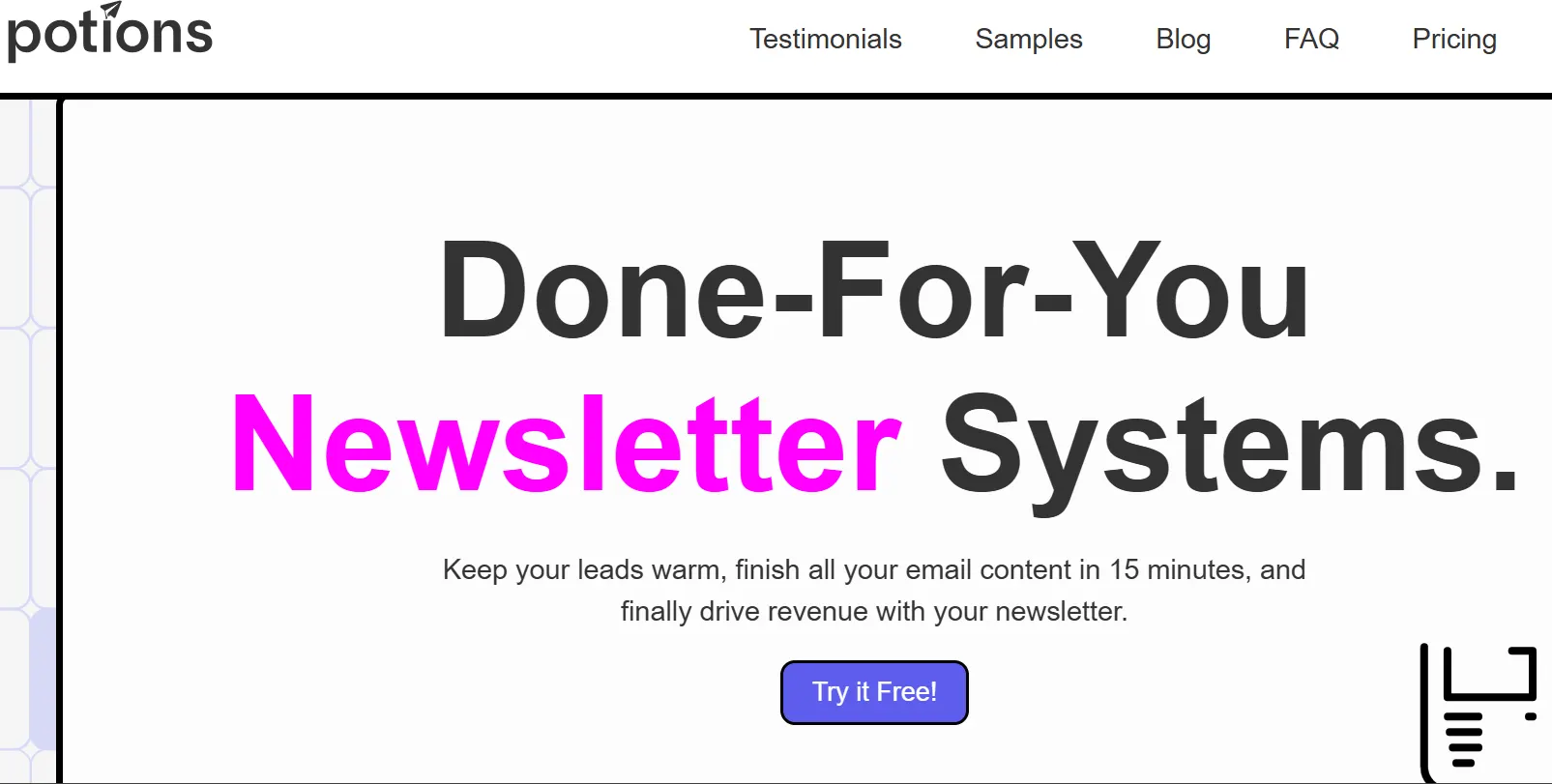
Potions Review: The AI-Powered Done-For-You Newsletter System That Builds Your Audience While You Run Your Business

Here's a tension that nearly every entrepreneur, founder, and creator faces at some point: you know email newsletters work. The data is clear, the case studies are compelling, and every digital marketing expert you follow seems to be saying the same thing — build your list, own your audience, send consistently. You understand the logic. You even want to do it. But somewhere between the intention and the actual execution, the newsletter keeps getting pushed to the back of the queue. There's always a product feature to ship, a client to serve, a meeting to take. The newsletter waits. Weeks pass. Then months. The opportunity compounds in the wrong direction.

And look — this isn't a willpower problem. It's a resource allocation problem. Running a good newsletter requires consistent time, dedicated writing bandwidth, a coherent strategy, and a growth plan that extends beyond simply hitting send on occasional emails. For most busy operators, those resources are already fully committed elsewhere. This is exactly the gap that done-for-you newsletter services are designed to fill — and it's where Potions has positioned itself.

Potions is built on a simple but important premise: newsletters are too valuable a channel to skip, but too time-intensive to run well as a side task. Its answer is to handle the operational and creative work of newsletter management on behalf of entrepreneurs and creators — letting them own an active, growing newsletter without becoming newsletter operators themselves.

⚡ Quick Summary: Is Potions Worth It?

  • What it is: A done-for-you newsletter system that handles content creation, strategy, and audience growth on your behalf.
  • Best for: Entrepreneurs, SaaS founders, consultants, coaches, agency owners, and creators who want a professional newsletter without managing every detail themselves.
  • Key advantage: Converts a consistently deprioritized high-value channel into a reliably operating business asset without requiring your writing time.
  • Worth considering if: You understand newsletter value but keep failing to execute consistently due to time or bandwidth constraints.
  • Verify pricing: Check Potions directly for current service plans — done-for-you newsletter pricing varies by scope and output volume.

What Is Potions?

Potions is a done-for-you newsletter service built for people who want the results of a well-run newsletter without personally becoming newsletter writers, editors, and strategists. It operates as a managed service rather than a self-serve software tool — and that distinction is what separates it from conventional email marketing platforms and newsletter infrastructure tools.

Where tools like Mailchimp, Beehiiv, or ConvertKit give you the infrastructure and then step back to let you operate everything yourself, Potions steps in to handle the actual work. Strategy development, content research, writing, editing, formatting, and delivery — these are the operational layers that Potions manages on behalf of its clients. You bring the subject matter expertise, the brand, and the audience context. Potions brings the execution capacity to turn that into a consistently published, professionally crafted newsletter.

The target audience is intentionally focused. Potions isn't designed for newsletter creators who genuinely love writing and want more tools to support their craft. It's designed for entrepreneurs, startup founders, SaaS business owners, consultants, coaches, and agency owners who see the commercial value in newsletters — thought leadership, audience ownership, lead nurturing, client retention — but can't realistically allocate the sustained time and creative energy a quality newsletter demands.

The core value proposition is deceptively simple: a newsletter that actually gets published, consistently, with quality content your audience wants to read — without that work sitting on your plate every week. For businesses where a newsletter represents a meaningful growth or retention channel, that promise carries real weight.

Why Newsletter Growth Has Become Difficult

Understanding why done-for-you newsletter services have emerged as a genuine category requires being honest about how challenging it actually is to grow and sustain a newsletter operation over time. The barriers are real, and they don't discriminate based on the size or ambition of the business behind the newsletter.

The Content Creation Bottleneck

Writing a newsletter isn't just writing. It involves researching topics your audience cares about, synthesizing information into something genuinely valuable rather than regurgitated noise, structuring a narrative that holds attention from subject line to sign-off, and editing that output to a standard that reflects well on your brand. Done well, that's a multi-hour commitment per issue. For entrepreneurs already working full-time on their business, that time simply isn't available at a reliable cadence.

The result is a pattern most newsletter operators recognize all too well: a burst of enthusiasm at launch, a reasonable consistency through the first few weeks, and then a gradual slowdown that eventually becomes an irregular schedule — until the newsletter quietly stops. The intention never goes away. The execution does.

Audience Engagement Challenges

Publishing consistently is necessary but not sufficient. A newsletter that sends regularly but fails to engage its readers will see open rates decline, unsubscribes accumulate, and the list gradually shift from an asset into a liability. Engagement requires understanding what your specific audience wants to read, testing different approaches, interpreting performance signals, and iterating based on what the data tells you. That's strategy work on top of the content creation work — and it requires its own sustained attention that most solo operators simply don't have.

Consistency Under Pressure

Business life isn't linear. There are product launches, busy seasons, team crises, travel schedules, and personal obligations that all compete for time and attention. A self-operated newsletter is usually the first casualty when something urgent arrives. Done-for-you systems remove this dependency — your newsletter ships regardless of what else is happening in your business, because someone else is responsible for making that happen.

Technical Setup and Deliverability

Before a single word reaches a subscriber's inbox, there's a technical infrastructure to build and maintain: domain authentication, deliverability configuration, list hygiene, segmentation logic, analytics tracking, and integration management. For non-technical founders and creators, this layer alone is enough to delay newsletter launches indefinitely. Even for technical founders, it represents a setup investment that competes with higher-priority engineering priorities.

Scaling Past the Founding Phase

The newsletter that works for five hundred subscribers looks very different from the one that works for fifty thousand. List growth brings new challenges around segmentation, personalization, content consistency across a larger and more diverse audience, and monetization strategy. Scaling a newsletter well requires evolving the approach as the audience grows — a continuous strategic investment that most solo operators aren't resourced to make while simultaneously growing their core business.

The honest math: A well-crafted weekly newsletter might require four to six hours of research, writing, and editing per issue. Over a year, that's two hundred to three hundred hours of committed creative output — the equivalent of five to seven weeks of full-time work. For a founder or consultant whose time generates real business value elsewhere, outsourcing that labor to a service like Potions is an economically rational decision, not just a convenience.

How Potions Works

Done-for-you newsletter services follow a structured operational model designed to minimize the client's time investment while maintaining quality and consistency. Here's a general walkthrough of how Potions' approach to newsletter management works in practice.

Step 1 — Discovery and Onboarding: The engagement begins with a thorough intake process covering your business, your audience, your goals for the newsletter, and your brand voice. This is the foundation for everything that follows — the team needs to understand not just what you do but how you communicate, what your subscribers value, and what business outcomes the newsletter is meant to drive.

Step 2 — Brand Voice Development: Based on the discovery session, the team develops a documented brand voice guide that captures your communication style, tone, preferred phrasing, topics to engage with, and topics to avoid. This guide is the reference point for all content produced on your behalf, ensuring that what lands in your subscribers' inboxes sounds like you — not a generic content team.

Step 3 — Newsletter Strategy Design: Before writing a single issue, a content and growth strategy gets established. What topics will the newsletter cover? What's the publishing cadence? How will growth be approached? What engagement and conversion goals should the newsletter serve? These strategic decisions shape the content calendar and determine how success is measured.

Step 4 — Content Research and Creation: With strategy in place, the team handles the ongoing research, writing, and editing for each issue. Content is developed according to the established topics, tailored to your voice, and formatted for your specific newsletter platform. Each issue goes through an editorial review before it reaches you for approval.

Step 5 — Client Review and Approval: You receive each issue before it's sent. This review window gives you the opportunity to approve the content as-is, request specific edits, or provide feedback that informs future issues. Nothing goes to your list without your sign-off — editorial control stays with you even though the creation work doesn't.

Step 6 — Distribution and Delivery: Once approved, the newsletter is scheduled and delivered through your email infrastructure on the established publication date. Timing, subject line optimization, preview text — these distribution details are managed as part of the service rather than left to you to configure manually.

Step 7 — Performance Monitoring and Iteration: After each issue goes out, performance metrics are tracked — open rates, click-through rates, subscriber growth or churn, engagement trends over time. These data points inform the next round of content and strategy decisions, creating a feedback loop that improves the newsletter's effectiveness the longer the engagement continues.

Key Features of Potions

The specific capabilities of a done-for-you newsletter service are what separate an effective provider from one that simply takes work off your plate without actually improving outcomes. Here's a closer look at the features that define a well-structured system like Potions.

Done-For-You Content Creation

The cornerstone of the service is content creation that doesn't require your writing time. Research, drafting, editing, and formatting happen entirely outside your workday — the output arrives in your review queue as a near-finished product rather than a rough draft that needs substantial rework from you.

What this means in practice: your subscribers receive well-researched, clearly written, genuinely useful newsletter issues at regular intervals. They don't experience the inconsistency that typically signals a solo operator losing bandwidth. To your audience, the newsletter feels like it comes from a business that takes communication seriously — which, through Potions, it does.

And the real-world benefit extends beyond reader experience. Consistent, high-quality content is the primary driver of organic newsletter growth through word-of-mouth recommendations, social sharing, and the simple reality that people forward useful emails to colleagues and peers who might find them valuable.

Newsletter Strategy and Planning

Content without strategy is just output. Potions' approach to done-for-you service should include a strategic layer that addresses not just what to write but why — how each issue connects to broader business goals, how the newsletter serves different stages of the customer journey, and how the content mix evolves based on what the audience actually responds to.

A content calendar planned in advance rather than assembled issue-by-issue is one of the most tangible advantages of a structured done-for-you system. It allows for deliberate topic sequencing, planned promotions, and thematic consistency across issues — things that rarely happen when newsletter content is created reactively, one week at a time, under time pressure.

Audience Growth Systems

Growing a newsletter list beyond slow organic accumulation requires active growth mechanisms: referral programs, cross-promotion with complementary newsletters, lead magnet strategies, landing page optimization, and social amplification of newsletter content. These are standard components of a serious newsletter growth strategy that most solo operators never actually implement because the work involved competes with everything else.

A done-for-you service that only handles content creation without addressing growth is just helping you produce output for a static audience. Potions' system includes growth strategy as part of the service — the goal being not just to maintain your newsletter but to actively expand the audience it reaches over time.

Automation and Workflow Management

Behind every delivered newsletter issue is an operational workflow: scheduling, platform configuration, list management, welcome sequence setup, and onboarding automation for new subscribers. These tasks require setup attention up front and ongoing maintenance as the list evolves. Managing this infrastructure in-house adds hidden overhead to the newsletter operation.

Potions absorbs this operational layer as part of the service. Welcome emails, subscriber segmentation, automated onboarding sequences, and delivery scheduling are managed on your behalf — the infrastructure runs cleanly without requiring your attention after the initial setup is complete.

Analytics and Performance Reporting

Data without interpretation is noise. A meaningful analytics function in a done-for-you newsletter service goes beyond sending you a weekly spreadsheet of open rates — it translates performance signals into actionable adjustments. Which topics generated the most engagement? Which subject lines drove the highest open rates? Which issues led to meaningful click activity toward your products or services? What's the subscriber growth trend telling you about acquisition channel effectiveness?

Regular performance reviews should be part of the ongoing service relationship, keeping you informed of how the newsletter is performing against its goals without requiring you to spend hours pulling and interpreting data yourself. The service should surface insights, not just metrics.

Brand Voice Consistency

One of the most legitimate concerns entrepreneurs raise when considering a done-for-you service is authenticity. Will the newsletter actually sound like me, or will it read as obviously outsourced content? This concern is totally reasonable, and addressing it well is what separates effective done-for-you services from mediocre ones.

A well-structured voice development process — drawing on your existing content, your communication style, your writing samples, and ongoing calibration through feedback — produces output that readers experience as genuinely coming from you. This isn't about mimicry; it's about understanding your perspective deeply enough to express it consistently even when you're not in the room.

Benefits of Using Potions

The advantages of a done-for-you newsletter system accumulate over time, compounding in ways that short-term evaluations tend to undercount. Here's a comprehensive look at what the service model actually delivers.

  • Reclaimed time: Four to six hours per issue that would otherwise come out of your most productive work hours are redirected back to higher-leverage activities in your business.
  • Elimination of the consistency problem: The newsletter ships on schedule regardless of how busy your business gets — a fundamental shift from the feast-or-famine pattern of self-managed newsletters.
  • Professional quality baseline: Every issue meets a consistent editorial standard rather than varying based on how much time you happened to have this week.
  • Active audience growth: Rather than growing slowly by default, the newsletter benefits from deliberate subscriber acquisition strategy built into the service.
  • Expert strategic oversight: Newsletter strategy developed by people who do this professionally rather than improvised week-to-week by a busy founder.
  • Scalable operations: As your list grows, the service scales with it — you don't need to hire and manage in-house newsletter staff to handle increased volume.
  • Audience relationship maintenance: Regular, valuable communication keeps your relationship with subscribers active even during periods when your own bandwidth is fully consumed.
  • Brand authority development: Consistent thought leadership content positions you and your business as knowledgeable voices in your space — a competitive advantage that compounds with every issue.
  • Revenue channel activation: A growing, engaged newsletter list is a direct revenue channel through sponsored content, product promotions, and service offers embedded in regular issues.
  • Reduced creative burnout: Eliminating the pressure to produce regular newsletter content while running a business removes a meaningful source of creative drain from your workweek.
  • Data-informed improvement: Performance monitoring and strategic iteration mean the newsletter gets measurably better over time rather than plateauing at whatever baseline was established at launch.
  • Editorial control without execution burden: You review and approve before anything goes out — quality control stays in your hands, execution doesn't.

Real-World Use Cases

The business case for a done-for-you newsletter service looks meaningfully different depending on who's using it and what commercial outcome they're optimizing for. Here are realistic scenarios that illustrate where Potions delivers genuine value.

Solopreneurs

The Solopreneur Running a One-Person Consulting Practice

A solo consultant in a specialized field — HR technology, supply chain, financial planning — knows that thought leadership content builds trust and keeps them top of mind with potential and existing clients. A weekly or bi-weekly newsletter sharing genuine insight from their area of expertise is an ideal vehicle for this. The problem is that client work always takes priority, and the newsletter keeps getting delayed. Potions provides the operational capacity to keep the newsletter running consistently — maintaining the consultant's visible expertise without competing for the hours they need to actually deliver for clients.

Startup Founders

The Early-Stage Founder Building a Pre-Launch Audience

For founders building in public or targeting a niche market before a full product launch, a newsletter is one of the most effective tools for building an engaged audience before they have something to sell. A done-for-you service lets the founder maintain a consistent communications channel — sharing industry observations, problem-space insights, and early thinking — while their actual bandwidth is consumed by product development and fundraising. By launch, they have an audience rather than starting from zero.

SaaS Businesses

The SaaS Founder Nurturing a Long Sales Cycle

SaaS products often involve sales cycles measured in weeks or months — particularly in the B2B space. A newsletter that delivers consistent value to prospects throughout that decision period keeps the relationship active and the product top of mind during a window when competitors are equally present. Potions enables a SaaS business to operate this nurture channel professionally without dedicated content headcount — particularly valuable for teams at the growth stage where every hire competes with product and engineering priorities.

Agencies

The Agency Owner Who Wants a Thought Leadership Newsletter

Agency owners often have distinctive perspectives on their industry — informed by patterns they see across client engagements — that would resonate strongly with a newsletter audience of potential clients. But agency work is notoriously demanding of the owner's time and attention. A done-for-you newsletter lets the agency owner establish a consistent public voice in their industry without carving writing time from an already packed schedule. Over time, that newsletter becomes a lead generation asset — prospects who've been reading for months arrive at sales conversations already pre-sold on the agency's expertise.

Coaches and Consultants

The Business Coach Scaling Their Content Presence

Coaches who've moved beyond one-on-one client work into group programs, courses, or digital products need content that reaches a much larger audience than direct client relationships allow. A newsletter is a natural vehicle for this — but scaling from serving clients to consistently publishing for thousands of subscribers requires a different production capacity than most coaches have available. Potions bridges this gap, enabling a coach to maintain an active newsletter presence at scale without hiring a full content team or reducing client-facing hours.

Content Creators

The Creator Diversifying Beyond Social Platforms

Creators who've built audiences on social platforms — YouTube, Instagram, LinkedIn, TikTok — increasingly understand the risk of building entirely on rented land. Platform algorithms change, accounts get flagged, reach gets throttled. A newsletter list is an owned channel: direct access to your audience that no platform can take away. But running a newsletter on top of content creation for three or four social platforms is a significant additional workload. Potions provides the capacity to own that direct audience relationship without it becoming yet another full content stream to manage.

E-commerce Businesses

The E-Commerce Brand Building Customer Loyalty

Email remains one of the highest-ROI channels in e-commerce — but most e-commerce newsletters are promotional rather than editorial, which limits engagement over time. A newsletter that delivers genuine value through curated content, category insight, or lifestyle material alongside product updates builds the kind of subscriber relationship that makes promotional messages far more effective. Potions can help an e-commerce brand develop this editorial dimension to their email program without diverting team attention from operations and fulfillment.

Potions vs Traditional Newsletter Management

Putting a done-for-you newsletter service alongside traditional self-managed newsletter operations reveals where the genuine trade-offs sit — and why the comparison isn't simply a question of cost.

Aspect Self-Managed Newsletter Potions Done-For-You System
Setup Owner handles platform configuration, authentication, and technical setup Setup managed as part of onboarding — infrastructure ready without owner involvement
Time commitment 4–8+ hours per issue for research, writing, editing, and formatting Minimal — focused on review and approval rather than creation
Content creation Owner writes, or manages a freelance writer independently Content researched, written, and edited by the Potions team
Publishing consistency Varies with owner's availability — often irregular under business pressure Consistent schedule maintained regardless of owner's workload
Growth strategy Ad hoc or absent — rarely treated as a dedicated priority Active subscriber acquisition strategy built into the service
Editorial quality Varies based on the owner's available time and energy that week Consistent editorial standard maintained across every issue
Scaling List growth creates proportionally more work for the owner Service scales with list growth without proportional owner time increase
Analytics and iteration Owner reviews metrics when time permits — often infrequently Performance monitored and integrated into ongoing strategy adjustments
Cost structure Low direct cost but high hidden cost in owner time Service fee replaces the cost of owner time and freelance coordination
Outcome reliability Highly dependent on owner motivation and available bandwidth Outcomes driven by a dedicated team with accountability to deliver

Potions vs Other Newsletter Solutions

The newsletter service landscape includes a mix of infrastructure platforms, growth tools, and service providers. Understanding how Potions compares with the alternatives helps clarify who the right audience for each option actually is. And honestly, the comparison changes a lot depending on what your primary constraint is.

Solution Type Who Operates It Content Creation Growth Support Best For
Potions Done-for-you service Potions team Handled for you Active strategy included Busy operators who want results without doing the work
Beehiiv Newsletter platform (SaaS) You You write everything Tools provided, strategy is yours Dedicated newsletter creators who want best-in-class infrastructure
Substack Publishing platform (SaaS) You You write everything Discovery features, no managed growth Writers building direct subscriber relationships with paid options
ConvertKit / Kit Email marketing platform (SaaS) You You create all content Automation tools, no managed strategy Creators monetizing audiences through sequences and broadcasts
Hiring a Freelancer Individual contractor You manage them Writer produces content Separate from writer — strategy still owner-led Owners who want content help but want to manage strategy themselves
Content Agency Service provider Agency team Typically included Often strategy-only, not newsletter-specific Businesses needing broad content services beyond newsletters

The most important distinction in this comparison is the difference between tools and service. Beehiiv, Substack, and ConvertKit are excellent platforms — but they're infrastructure that requires you to bring the content and strategy. Potions is a service that brings the content and strategy to you. Neither is universally superior — the right choice depends entirely on whether your primary constraint is tools or bandwidth.

Pros and Cons

✓ Pros

  • Newsletter operates consistently without requiring your writing time
  • Professional content quality maintained across every issue
  • Active subscriber growth strategy built into the service
  • Editorial control remains with you through the review and approval process
  • Brand voice development ensures content sounds authentically like you
  • Operational infrastructure managed without owner involvement
  • Scales with list growth without proportional increase in owner workload
  • Performance data monitored and converted into strategic adjustments
  • Eliminates the consistency problem that derails most self-managed newsletters
  • Converts a perpetually-deprioritized channel into a reliably active asset
  • Revenue channel activation through a consistently engaged list
  • Reduces creative drain from a founder's already demanding workweek
  • Builds brand authority through sustained thought leadership output

✗ Cons

  • Higher cost than self-serve newsletter platforms — positioned as a service, not a SaaS tool
  • Initial brand voice calibration takes time and feedback cycles to get right
  • Less immediate creative control than writing every issue yourself
  • Not designed for creators who genuinely love writing their own newsletter
  • Dependent on effective communication of your perspective during onboarding
  • ROI requires an engaged audience for whom the newsletter has commercial value
  • Pricing and service scope best verified directly with the team

Who Should Use Potions?

A done-for-you newsletter service isn't the right solution for every business — being specific about who genuinely benefits most produces a more useful recommendation than claiming it's right for everyone.

Entrepreneurs and founders who've consistently intended to start or improve a newsletter but keep deprioritizing it due to competing demands are the clearest beneficiaries. Potions converts that intention into a reliably operating channel without requiring a change to how the founder allocates their time.

Service-based business owners — consultants, coaches, agencies — who operate in spaces where relationships and trust drive client decisions will find newsletter-based thought leadership particularly valuable. The commercial case for consistent audience communication is strong in these businesses, and Potions provides the production capacity to make it happen without diverting time from client delivery.

SaaS founders managing long sales cycles benefit from a nurture channel that maintains subscriber engagement through extended decision periods. A newsletter that delivers consistent value to prospects over months converts better than one-off marketing touchpoints — but it requires consistent publishing to work, which Potions makes operationally sustainable.

Content creators who've built social audiences and want to establish an owned, platform-independent subscriber list will find Potions valuable for running the newsletter channel in parallel with their primary content creation work — without the newsletter becoming a full production stream in its own right.

Who should probably look elsewhere: Writers and creators who genuinely enjoy crafting their own newsletter — for whom the writing itself is part of the value they deliver to subscribers — are better served by excellent infrastructure platforms like Beehiiv or Substack that support their craft. Similarly, very early-stage businesses where the primary newsletter work is simply building an initial list organically may not yet need the service depth Potions provides.

Pricing and Value Considerations

Done-for-you newsletter services are priced as professional service engagements rather than SaaS subscriptions — and this distinction matters for how you evaluate the cost. You're not paying for software access; you're paying for skilled labor, strategic expertise, and operational capacity applied to your newsletter on an ongoing basis.

Without quoting specific numbers that may be outdated or inaccurate, the right frame for evaluating Potions' cost is ROI rather than direct cost comparison. Compare it not against the monthly fee for Mailchimp or Beehiiv, but against what your newsletter is actually worth to your business when it runs consistently and well.

For a consultant who closes one new client engagement per quarter from newsletter-driven relationships, the revenue impact of a reliably operating newsletter almost certainly exceeds the service cost by a significant margin. For an agency where a single newsletter-attributed retainer represents tens of thousands in annual revenue, the same logic applies even more forcefully. The math changes depending on your business model and the commercial value of your subscriber relationships.

There's also the time cost to consider honestly. If your most valuable working hours generate meaningful output — in billable client work, product development, or revenue-generating activities — then the hours you spend writing, editing, and managing a newsletter represent a real opportunity cost, not just an inconvenience. A service that absorbs those hours for a fixed monthly fee may represent a favorable economic trade even before accounting for the newsletter's direct commercial impact.

For accurate current pricing, contact Potions directly. Service costs in this category vary based on output volume, list size, publication cadence, and the specific scope of services included. Evaluate the investment against the commercial opportunity your newsletter represents at realistic subscriber engagement levels.

Tips for Getting the Most Out of Potions

A done-for-you service delivers better results when the client shows up as an informed and communicative partner in the early stages. A few things that genuinely help.

  • Invest time in the onboarding process: The quality of your newsletter's brand voice and strategic alignment is largely determined in onboarding. Treat this phase seriously — bring examples of content you admire, articulate your communication style clearly, and be specific about your audience and goals. Don't rush through this.
  • Share existing content assets: Blog posts, podcast episodes, past emails, social media threads — anything you've already produced gives the content team raw material for understanding how you think and communicate. The more input they have, the more accurately they can represent your voice.
  • Be specific in your review feedback: When reviewing draft issues, "this doesn't sound like me" is less actionable than "I'd phrase this more directly" or "I never use this kind of formal language with my audience." Specific feedback calibrates the voice faster and reduces back-and-forth.
  • Communicate when your business context changes: If you launch a new product, close a funding round, bring on a notable client, or shift your strategic focus, tell your newsletter team. These developments belong in the newsletter, and they can only incorporate them if you communicate them proactively.
  • Define success metrics at the start: Know what you're optimizing for before the first issue goes out. Subscriber growth? Open rate benchmarks? Leads generated? Engagement quality? Clear goal definition enables meaningful performance evaluation — and keeps everyone on the same page about what "working" actually means.
  • Resist the temptation to overwrite approved drafts: If a draft is close but not quite right, give specific feedback rather than rewriting it yourself. Every time you rewrite instead of redirecting, you slow down the team's ability to calibrate your voice independently — which delays the point where drafts arrive already close to perfect.
  • Promote the newsletter actively in your other channels: The service handles the newsletter itself, but growth is a shared effort. Mentioning your newsletter in social content, adding it to your email signatures, and including it in onboarding flows for new contacts amplifies what the growth strategy can achieve.
  • Review performance reports and engage with the insights: When the team shares performance data and strategic recommendations, actually engage with them. Your business context informs how the data should be interpreted — the team has the newsletter metrics, but you have the business knowledge to make sense of what they mean.

The Future of Done-For-You Newsletter Systems

The category of done-for-you newsletter services is maturing rapidly, and several structural trends are shaping where it's headed over the next few years.

AI-assisted content creation is already changing the economics and capability of done-for-you services. The combination of AI-generated research synthesis and human editorial judgment is letting service teams produce higher-volume, higher-quality content at costs that would've been impossible even two years ago. This means done-for-you newsletter services can serve a broader range of business sizes and budgets than was previously practical — moving from an offering available only to established businesses into something accessible to ambitious early-stage operators as well.

Personalization is the next frontier. Newsletters that send the same content to every subscriber are already showing engagement patterns that reveal their limitations — different subscribers in different stages of the buyer journey, with different levels of existing knowledge, respond very differently to identical content. The next generation of newsletter systems will deliver dynamically personalized content based on subscriber behavior, stage, and engagement history — a level of sophistication that becomes much more achievable when AI is handling the content generation layer.

The creator economy's continued growth is expanding the commercial case for newsletter ownership. As more entrepreneurs, experts, and professionals recognize the business value of owned audience relationships, demand for services that make newsletter operation accessible without massive personal time investment will grow alongside it. Done-for-you services are well-positioned to serve this expanding market — particularly as the sophistication gap between professional newsletter operators and casual self-managed newsletters becomes increasingly visible in engagement and growth metrics.

Integration with AI-powered tools for distribution, analytics, and audience intelligence will make the service model even more powerful. Real-time insights into what content resonates, predictive modeling of subscriber behavior, and automated A/B testing of subject lines and content formats — these capabilities are already emerging in parts of the newsletter ecosystem and will become standard components of well-structured newsletter services over the next few years.

The fundamental economics of the creator economy favor services that remove execution friction from high-value channels. Newsletters are the clearest case study: enormous demonstrated commercial value, significant operational demands, and a large population of potential operators who understand the value but lack the bandwidth to capture it. Done-for-you services like Potions exist precisely at this intersection — and the opportunity they serve isn't getting smaller.

Frequently Asked Questions

What is Potions?

Potions is a done-for-you newsletter system designed for entrepreneurs, creators, startups, and businesses who want to operate a professional newsletter without personally managing every aspect of content creation, strategy, and distribution. Rather than being a self-serve email marketing tool, Potions handles the operational and creative heavy lifting of newsletter management so business owners can focus on their core work.

How is Potions different from email marketing tools like Mailchimp or Beehiiv?

Traditional email marketing tools give you the infrastructure to send newsletters — but you still create all the content, plan all the strategy, and manage all the growth work yourself. Potions operates differently: it's a done-for-you system where the content creation, strategic planning, and newsletter operations are handled on your behalf. The distinction is the difference between a SaaS tool you operate and a service that operates for you.

Do I need to write anything if I use Potions?

Done-for-you services like Potions are designed to minimize the writing time required from you. The content research, drafting, editing, and formatting are handled by the service team. You typically provide direction, brand voice input, and approval sign-off — spending time reviewing near-finished drafts rather than creating content from scratch. Your primary role shifts from writer to editorial decision-maker.

Who is Potions best suited for?

Potions is best suited for entrepreneurs, startup founders, SaaS business owners, consultants, coaches, agency owners, and creators who see clear value in owning a newsletter audience but lack the time, writing bandwidth, or newsletter expertise to run one consistently. It's particularly valuable for busy operators who understand newsletters matter for their business but keep deprioritizing the work because other priorities always win.

Can Potions help grow my newsletter audience?

Yes. A core part of done-for-you newsletter services like Potions goes beyond content creation to include growth strategy. This typically involves subscriber acquisition tactics, referral mechanisms, cross-promotion opportunities, landing page optimization, and engagement strategies designed to expand your list actively rather than just maintain it. Consistent, high-quality output is itself one of the strongest drivers of organic newsletter growth through reader recommendations and social sharing.

How does Potions maintain my brand voice?

Done-for-you newsletter services begin with a brand voice and style intake process — gathering your communication preferences, tone, existing content examples, and audience context. This documentation forms the foundation for all content produced on your behalf. The content team refines its understanding of your voice through ongoing collaboration and feedback cycles, producing output that reads authentically as yours rather than as generic outsourced content.

Can I review newsletters before they go out?

Yes. The review and approval step is a standard component of done-for-you newsletter services. You receive each draft before it's sent, with sufficient lead time to request revisions or provide feedback. Nothing goes to your subscriber list without your sign-off — editorial control remains with you even though the creation work doesn't.

What types of businesses benefit most from Potions?

Businesses with subject-matter expertise they want to share at scale, service businesses that benefit from thought leadership, and SaaS companies nurturing long sales cycles all see strong returns from consistent newsletters. Potions is particularly well-suited for operators who generate meaningful value per relationship — consultants, coaches, agency owners, and B2B founders — where a single newsletter-driven conversion can justify months of service cost.

How long does it take to launch with Potions?

Launch timelines for done-for-you newsletter services vary based on onboarding complexity, brand voice development, and initial content pipeline setup. Most well-structured services in this category are designed to move from onboarding to first issue publication within a few weeks rather than months. The exact timeline for Potions is best confirmed directly with the team during the initial inquiry process.

Is a done-for-you newsletter worth the investment?

The return on investment depends on the commercial value your newsletter delivers — leads generated, relationships maintained, authority built, and revenue influenced. For businesses where a well-run newsletter has clear commercial impact, the service cost is often significantly lower than the opportunity cost of continuing to run it inconsistently or not at all. Evaluate the investment against what your newsletter is actually worth to your business when it operates reliably rather than against the cost of a self-serve email platform.

What newsletter platforms does Potions work with?

Done-for-you newsletter services typically adapt to the infrastructure you already have — whether that's Beehiiv, Substack, ConvertKit, Mailchimp, or another platform — or help you select the right infrastructure if you're starting fresh. Confirm specific platform compatibility with Potions directly for the most accurate and current information.

How much does Potions cost?

Potions' pricing is best verified directly with the team, as done-for-you service costs vary based on output volume, publication cadence, list size, and specific scope of services. Done-for-you newsletter services are generally priced as professional service engagements rather than flat-rate SaaS subscriptions. Evaluate the cost against the commercial value a consistently operating newsletter delivers to your business rather than comparing it to self-serve email tool pricing.

Final Verdict

🏆 Our Assessment: Potions

Potions occupies a well-defined and genuinely useful position in the newsletter ecosystem. It's not a newsletter platform competing with Beehiiv or Substack on infrastructure features. It's not a content tool competing with AI writing assistants on generation speed. It's a done-for-you system designed to solve a specific problem that millions of entrepreneurs and creators share: they understand the value of owning a newsletter audience but can't consistently execute the work required to build and maintain one. Potions is the operational answer to that gap.

The service model is where Potions' value lies — and it's the right model for the right user profile. If your primary constraint is time and bandwidth rather than budget, and if your newsletter represents a meaningful growth or retention channel for your business, a done-for-you system that absorbs the execution work while leaving editorial control with you is a structurally sensible solution.

That said — the approach isn't universally optimal. Creators for whom the act of writing is central to their value proposition — whose subscribers follow them specifically for their voice and personal perspective — will find that outsourced content creation creates more friction than it removes. And businesses at very early stages where the newsletter audience is still being built from nearly zero may find that the strategic infrastructure of a full done-for-you service outpaces their current need.

But for the substantial population of entrepreneurs, founders, service-business operators, and creators who sit in the middle — who know a well-run newsletter would serve their business meaningfully, and who've demonstrated through consistent deprioritization that they won't sustainably execute it themselves — Potions represents something genuinely valuable: a reliable path to the newsletter they've been meaning to build, operated professionally, without requiring the operational bandwidth they've already fully committed elsewhere.

Interested in how AI, automation, and modern service models are transforming the way entrepreneurs and creators build audiences and grow businesses? Explore more original analysis and in-depth reviews on RapidFast — where we cover the tools and strategies that actually move the needle.